Warp Factories Turns Coding Agents Into a Cloud Software Factory
Warp CEO Zach Lloyd described Warp Factories on 18 August 2026 as cloud infrastructure for a software factory: coding agents through triage, specification, implementation, review, and verification. It is in closed beta. Qualified organizations get $10,000 of factory use to start.
PromptCrates Editorial
Staff Writer
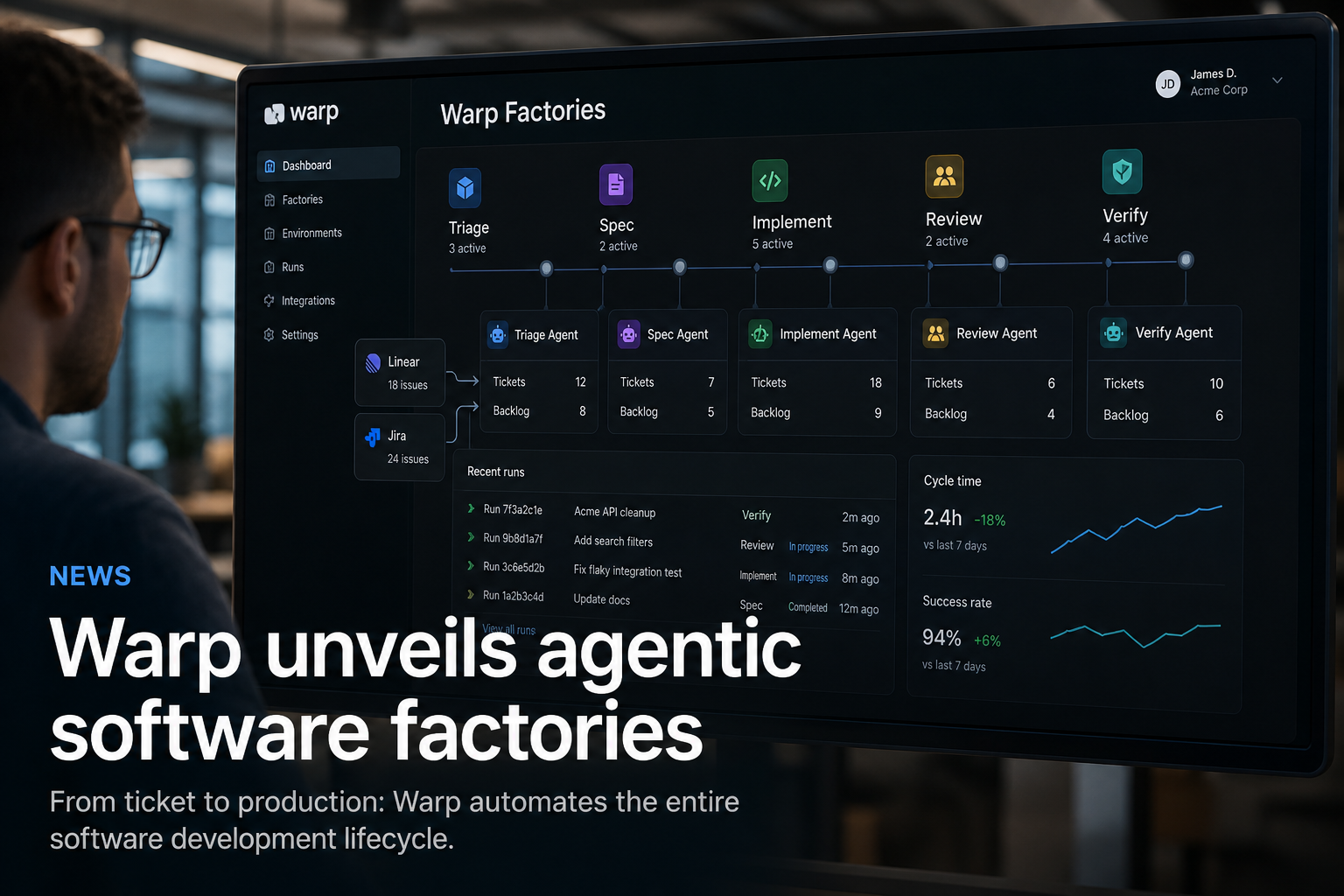
Warp CEO Zach Lloyd, speaking to TechCrunch’s Russell Brandom on 18 August 2026, described Warp Factories as cloud infrastructure for a “software factory”: a pipeline of coding agents through triage, specification, implementation, review, and verification.
The product is in closed beta. Warp is aiming at smaller companies that cannot build this plumbing themselves. Stripe and Ramp already rolled their own stacks internally. That is context for the market, not a claim that Warp Factories is those stacks.
Per-run pricing is not published. Request access. Qualified organizations in the closed beta get $10,000 of factory use to start.
What Warp Factories actually pipelines
The named stages are triage, specification, implementation, review, and verification. That is a software factory as an agent chain, not a new editor.
Warp Factories is model-agnostic. It can run Claude Code, Codex, Cursor, or open-weight models. It integrates Linear, Jira, Slack, and Teams.
Dashboards compare configurations and show token spend. Self-improvement loops are part of the pitch. Optional bring-your-own inference and zero-data-retention are on the list. If data terms matter to you — they should — read them the way you would for Cursor Origin’s unpublished data terms. Optional ZDR is not the same as a published default.
A factory that reviews its own diffs still needs a human gate. A code-review skill on a pull request should remain a stop, not a decoration. Warp is selling plumbing. You still write the review contract.
Who it is for, and what $10,000 buys
Target customers are smaller companies that cannot staff an internal agent platform. Stripe and Ramp are the named examples of firms that already built the plumbing in-house. They are not the closed-beta product.
Qualified orgs in closed beta get $10,000 of factory use to start. Warp has not published per-run pricing. Until it does, do not put a unit cost in a budget spreadsheet. Request access and ask.
Lloyd said Warp automates about 30–35% of its own tasks weekly and is not replacing engineers. That is a CEO figure for Warp’s own work, not a customer benchmark. Flag it as vendor-stated. Do not write “Factories replaces a third of the team.”
Self-improvement loops will change prompts over time. If a good chat becomes a standing pipeline stage, turn that chat into a reusable skill and pin the version. A loop that rewrites itself without a pin is a drift bug.
Practical takeaways
- Closed beta. Request access. Per-run price unpublished.
- $10,000 of factory use for qualified orgs at the start.
- Stages: triage, specification, implementation, review, verification.
- Models: Claude Code, Codex, Cursor, open-weight.
- Tickets and chat: Linear, Jira, Slack, Teams.
- Lloyd’s 30–35% is Warp’s own weekly mix, not yours.
Write the skill around the stage, not the vendor. “When a Linear ticket is labeled factory-ready, produce a spec, then a patch, then a review checklist.” Cap token spend per run using the dashboard, not a guess. If bring-your-own inference is on, name the endpoint in the skill header.
Do not treat closed beta as general availability. A missing price list is a product fact. Record it.
Sources
- Warp’s out-of-the-box software factory for AI development — TechCrunch, Russell Brandom, 18 August 2026
- Warp Factories — AI TLDR