OpenAI Puts GPT-5.6 Sol, Terra, and Luna in AWS Kiro
OpenAI and Amazon Web Services added GPT-5.6 Sol, Terra, and Luna to Kiro on 24 August 2026. Joint tests said Terra completed successful Terminal-Bench 2.1 tasks at about 82% lower cost.
PromptCrates Editorial
Staff Writer
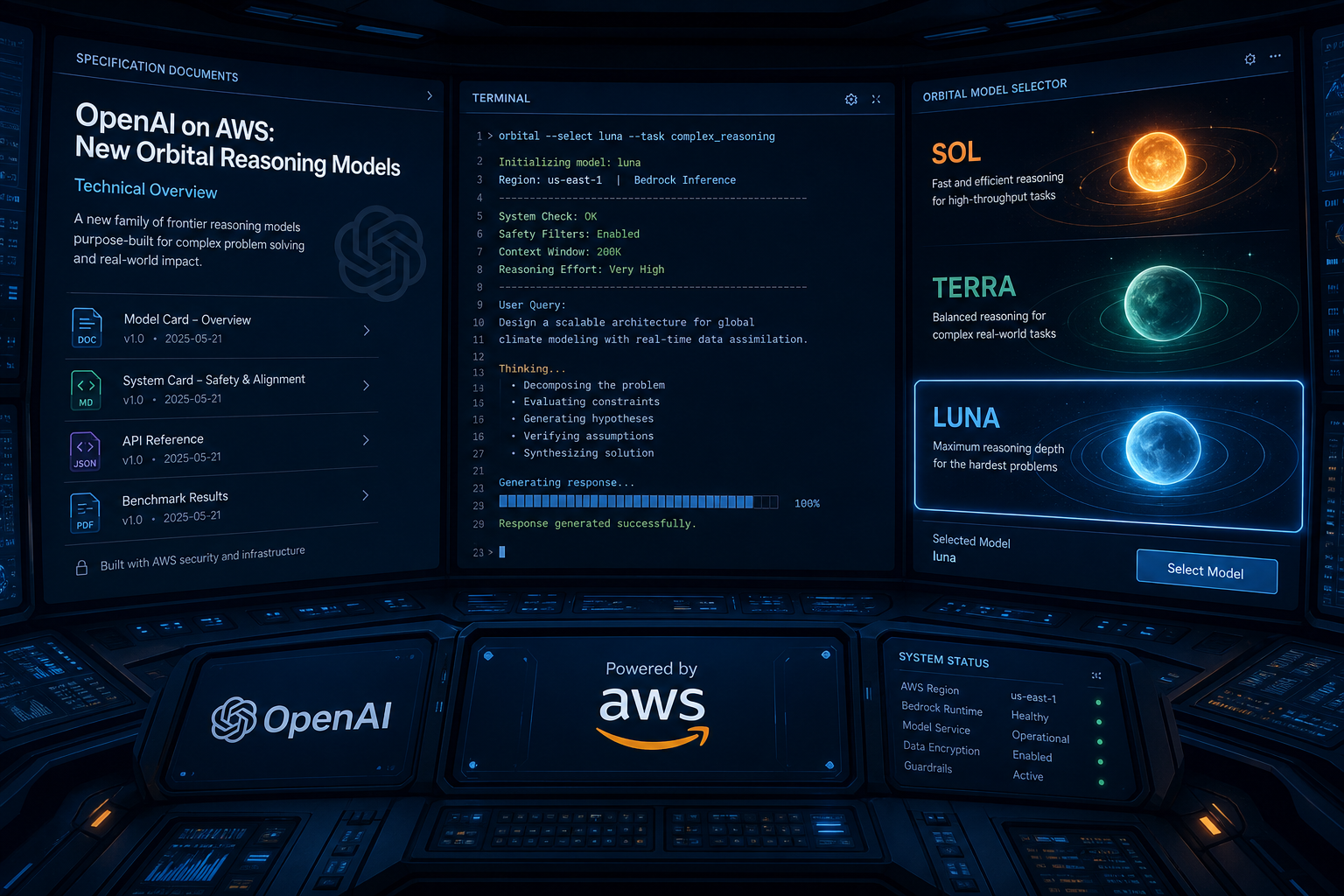
OpenAI and Amazon Web Services added GPT-5.6 Sol, Terra, and Luna to Kiro on 24 August 2026. In joint tests, GPT-5.6 Terra completed successful Terminal-Bench 2.1 tasks at about 82% lower cost.
What shipped inside AWS Kiro
OpenAI framed the launch as a product partnership, not a new model family. Kiro is Amazon's spec-driven coding agent. It already spans an IDE, a CLI, and a web client. Until this week it did not offer OpenAI models. Sol, Terra, and Luna now sit in that picker next to Anthropic.
The weights are not new. The surface is. Developers who already pay for Kiro get a second lab in the same spec loop.
OpenAI already cut GPT-5.6 Sol API and credit prices. This announcement is a different bill. Kiro charges its own credits. The public API price list does not apply inside the IDE.
All three tiers ship with a 272K context window. Kiro's launch post lists credit multipliers of 2.4x for Sol, 1.2x for Terra, and 0.6x for Luna. Those multipliers are how Amazon meters the work.
How Sol, Terra, and Luna split the work
AWS Kiro says Sol scored 80 on the Coding Agent Index and 88.8% on Terminal-Bench 2.1. Both figures sit above Claude Fable 5. The same post says Sol used less than half the output tokens and time.
Terra is the everyday button. It scored 77.4 on the Coding Agent Index, just above Fable 5's 77.2. The 82% cost claim is about Terra finishing successful Terminal-Bench 2.1 tasks. It is not a Sol number.
Luna is the cheap and fast option. AWS says it beats Claude Opus 4.8 on that same index, 74.6 versus 72.5, at about a quarter of Sol's cost.
Treat the table as vendor scores from the launch posts. Use it to rank the three buttons. Do not write it into a service-level agreement for your repo.
If you already buy IBM's dedicated GPT-5.6 consulting practice, keep that wrapper. Kiro is a coding agent. The consulting practice is a services lane. They do not replace each other.
Who can call the models, and what they hide
Access is experimental. It is rolling out to Kiro Pro, Pro+, Pro Max, and Power customers in AWS US-East-1 and Europe (Frankfurt), with cross-region inference. If you are not on those plans or in those regions, the picker will not appear yet.
The models hide chain-of-thought. Users see only final output. OpenAI says Kiro's spec-driven plans, checkpoint review, and property-based tests are what cut wasted tokens. That is a process claim, not a new tokenizer.
AWS's Swami Sivasubramanian and OpenAI's Colleen Kapase both framed the deal as giving developers more ways to match intelligence, speed, and spend to each coding stage. Three tiers exist so a plan, a review, and a cheap loop do not share one price.
If your team already parks work in Slack Code channels, treat Kiro as another agent seat. The spec still lives in the repo, not in the chat.
How to pin a tier in the spec, not the chat
Put the model name in the plan. A skill prompt that pastes "use the smartest model" into every turn is the pattern this picker is meant to retire. The skill should say: this job uses Terra unless the Coding Agent Index gap matters, then Sol; Luna is for cheap, fast loops; all three have 272K context; Kiro credits are 2.4x, 1.2x, and 0.6x; access is experimental in US-East-1 and Frankfurt.
If you already run cloud agent pipelines, this release is a model picker, not a new factory. Keep the checkpoint and the property-based tests. Do not paste the whole plan into every turn just because the window is 272K.
Measure three numbers on the first production path: successful Terminal-Bench-style tasks, output tokens, and wall time. Then decide whether Sol is worth 2.4x credits.
Sources
- GPT-5.6 in Kiro — OpenAI, 24 August 2026
- GPT-5.6 in Kiro — AWS Kiro, 24 August 2026