Keenable Raises $26 Million for an AI-Agent Web Search Index
Keenable came out of stealth with $26 million in seed funding, TechCrunch reported on 25 August 2026. Accel led the round for a startup that says it is building a web search index of more than 100 billion documents for AI agents.
PromptCrates Editorial
Staff Writer
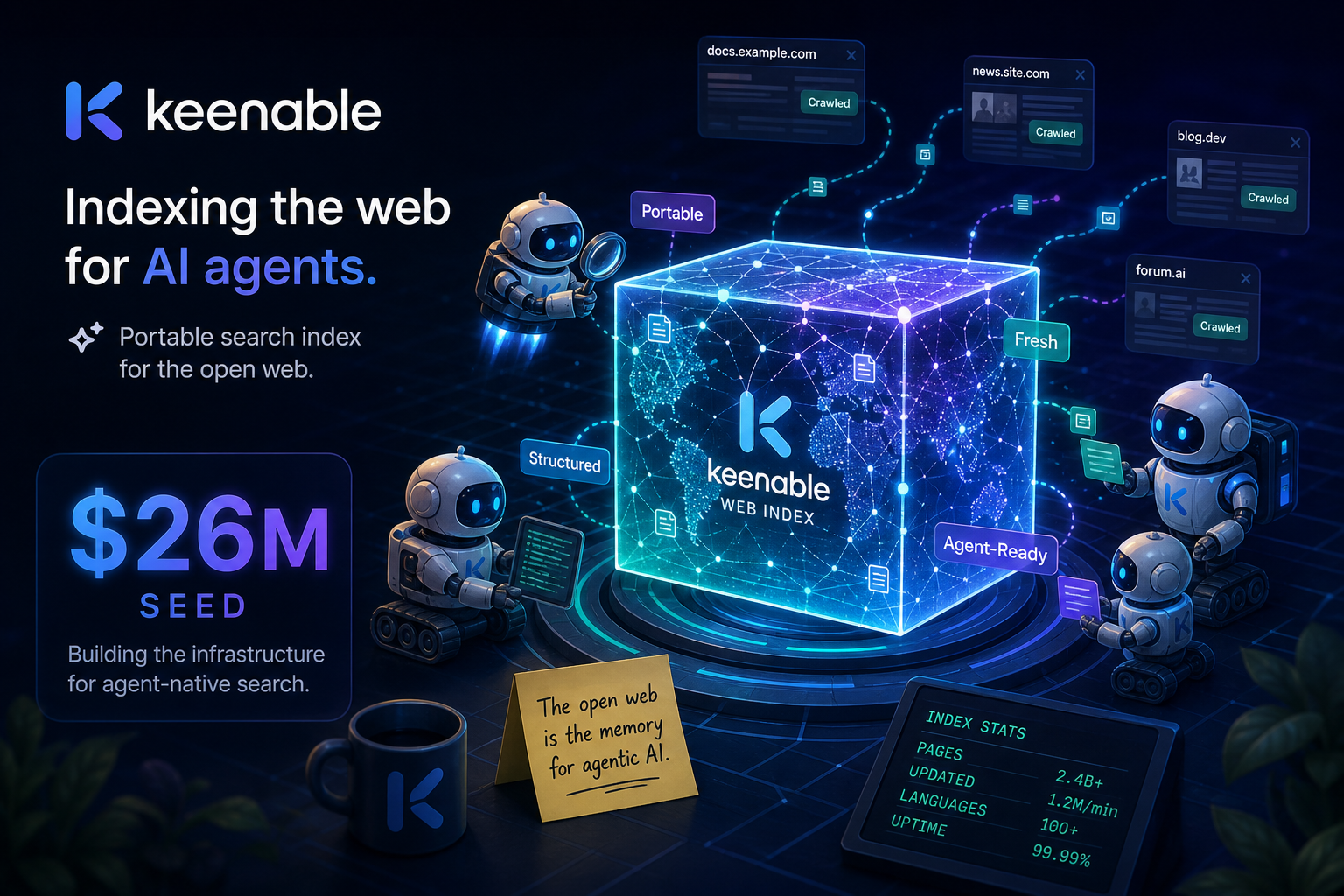
Keenable came out of stealth with $26 million in seed funding, TechCrunch reported on 25 August 2026. Accel led the round for a startup that says it is building a web search index of more than 100 billion documents so AI agents can ground answers in source pages.
What Keenable's web search index actually covers
The product is infrastructure, not a consumer search box. Keenable argues that classic search engines were built for people who will not read a whole page, while chatbots and agents can ingest much larger slices of the web. The company wants the index, and the serving path, designed for those machines.
Andrey Styskin previously led Yandex's search, AI, and cloud division. He and German AI scientist Matthias Petri founded the company after working together at Amazon on web search infrastructure for AI applications such as Alexa. Styskin's public case is simple: models do better when they can ground a reply in source documents, and that creates a flywheel different from the one Google learned from human clicks.
The index, Keenable says, already holds more than 100 billion documents. The API is already in production at several AI labs and inference providers, used in both training and runtime. The startup would not name those customers. The one named partner is Gradium, a voice AI company, for live information retrieval.
That is the verified commercial footprint: unnamed labs and inference hosts in production, plus Gradium. Do not write a logo wall. Do not invent a revenue figure. TechCrunch did not publish either.
Styskin said enterprise search products collapse, and get very expensive, at web scale unless the index structures are fine-tuned for a specific task. The cost of scanning the whole internet on every query is enormous. Keenable's pitch is to narrow the search space fast. That is the engineering claim. It is not a benchmark table.
If your agents already sit next to OpenAI models inside AWS Kiro, keep Kiro as the coding-agent surface. Keenable is the retrieval layer those agents might call when they need the live web. One is a spec loop. The other is an index.
Why Accel thinks the search APIs are closing
Accel partner Zhenya Loginov, who led the investment, said AI companies have few options for web-scale search infrastructure. Google and Microsoft, he said, have been shutting down existing search APIs to avoid cannibalizing their own products, and they now prefer bundled access with selected partners.
Styskin told TechCrunch those moves confirmed an opportunity he had already seen at Amazon, watching Cloudflare data that showed AI crawlers taking a growing share of search volume. Conviction Partners and unnamed angels joined Accel on the $26 million seed.
The competitive set in the same piece is Brave, Exa, and Google itself as it rebuilds search for the AI era. Styskin's stated ambition is to become "the next Google for AI agents." That is a founder quote, not a market-share fact. Pin it as ambition.
He also said it is "extremely hard" to pull people away from Google for human search, but that the innovator's dilemma makes the US giant "beatable" on agentic queries, where a smaller company can offer a more cost-efficient path to AI labs. Costs still hurt. "Don't ask — it is painfully expensive," he said of building the index. The company says it is pacing spend.
The team is 15 engineers in the United States and Europe, including former colleagues Styskin hired from his network. The new cash is earmarked to double headcount by the end of 2026 and to stand up a go-to-market motion. That is a hiring plan, not a booked sales number.
Upcoming work includes proprietary retrieval and Web Query Language, a product that would let an AI system compose an answer from several pages when no single document holds the full reply. TechCrunch described it as upcoming. Do not mark it generally available.
If your researchers already pull weights from a hub that Hugging Face may sell at $13 billion or more, keep that as a model-host story. Keenable is not a weight host. It is a web index for agents that need documents the hub does not store.
What this is not
It is not a Google replacement for human ten-blue-links search. Styskin said that fight is extremely hard. The wedge is agentic queries.
It is not a named-customer launch. Production use at "several" labs is a real claim with no logos. Gradium is the exception.
It is not a cheap index. The founder said the bill is painfully expensive. A 15-person team doubling by year-end is still a small company carrying a 100-billion-document corpus.
It is not Web Query Language in production. That product is on the roadmap.
It is not a proof that Google and Microsoft have fully exited the API market. Loginov's point is that the big platforms are bundling and choosing partners. Buyers should still ask which API they can actually contract.
Do not file this under coding-agent chat. If your org already runs work in Slack Code channels, that is a place people talk to agents about repos. Keenable is a place agents go to read the web. Different pipe.
What to pin in the retrieval wrapper
Put the size, the lead investor, and the missing customer names in a skill prompt. A line that only says "use web search" is the pattern this company exists to replace.
The skill should say: Keenable exited stealth on 25 August 2026 with $26 million seed led by Accel, with Conviction Partners and angels; founders Andrey Styskin and Matthias Petri; index of more than 100 billion documents; API already in production at unnamed AI labs and inference providers for training and runtime; Gradium partnership for live retrieval; Web Query Language is upcoming, not shipping; 15 engineers in the US and Europe, plan to double by end of 2026 for go-to-market; Loginov cites scarce web-scale search APIs as Google and Microsoft bundle; Styskin says human Google search is hard to displace and agentic queries are the opening.
If you evaluate Keenable, ask for the named production users, the query-latency band, and the price to scan a task-specific slice of that 100-billion-document index. Those three fields are not in the TechCrunch piece. Do not invent them. The useful changelog line is the $26 million, the 100 billion documents, the Accel lead, and the still-unnamed labs.
Sources
- Accel-backed Keenable is indexing the web for AI agents — TechCrunch, 25 August 2026