
UK and Ukraine Sign Avengers AI Labs Defense Partnership
The UK and Ukraine signed an AI defence partnership on 24 August 2026 that gives Britain access to Ukraine's Avengers AI Labs database. President Volodymyr Zelenskyy and Prime Minister Andy Burnham signed the deal in Ukraine.
PromptCrates Editorial
Staff Writer
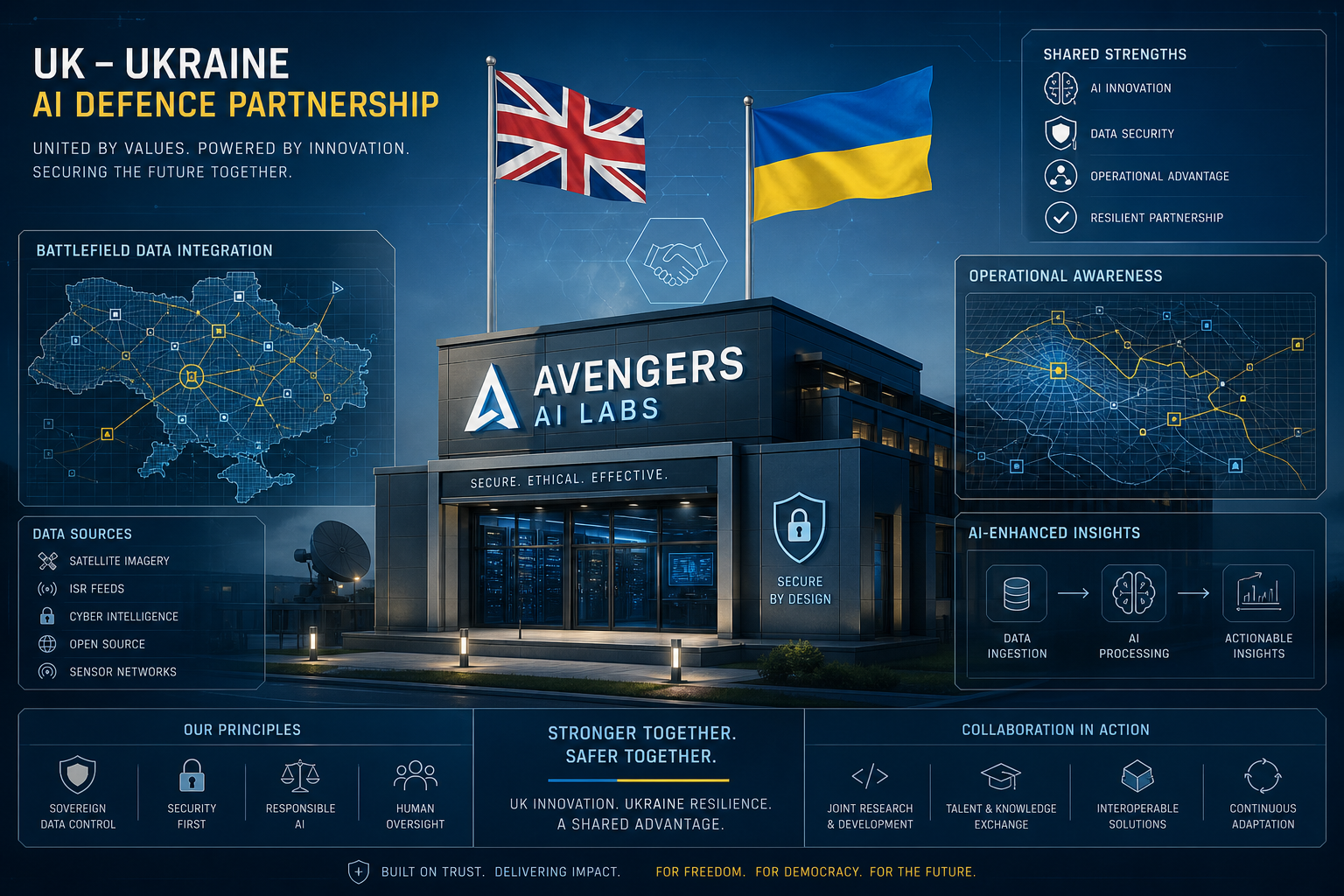
The UK and Ukraine signed an AI defence partnership on 24 August 2026 that gives Britain access to Ukraine's Avengers AI Labs database. President Volodymyr Zelenskyy and Prime Minister Andy Burnham signed the deal in Ukraine.
What Avengers AI Labs will share with Britain
The government notice calls Avengers AI Labs a goldmine of battlefield data. The platform trains models on real-world observations collected by thousands of daylight cameras and infrared sensors across the battlefield in Ukraine. Those sensors, the notice says, capture millions of objects — tanks, artillery, air-defence systems, infantry, and aerial targets including Shahed drones and reconnaissance UAVs — and feed that data back to the lab.
Britain's side of the bargain is access to that database plus a chance to "plug and play." Ukraine's side is access to what the notice calls the world's third-largest AI ecosystem: UK universities, researchers, and technology companies. The first focus is defence and national security. The same text says the data could later inform civilian systems such as air-traffic control and trains, but that is not the opening brief.
An AI cell of engineers, academics, businesses, and military operators from both countries is supposed to work the national-security problems. The partnership will also look at further platforms. The notice does not name those platforms. Do not invent them.
This is a government-to-government data and talent pact, not a public API. Do not write it as a dataset you can download. Do not write targeting instructions. The useful fact is access, the sensor types listed in the notice, and the first-use rule: defence first.
If your security team already tracks Anthropic's Claude Mythos 5 enterprise controls, keep that as a commercial model-security story. Avengers AI Labs is a wartime sensor archive shared under a bilateral deal. One is a product. The other is a state partnership.
Which UK pilots start first
The agreement already names three British startups: Sintela in Bristol, Mind Foundry in Oxford, and Skyral in London. Several pilot projects have been rolled out with those firms.
The first trial technology is about to go onto a UK defence site. It uses Ukrainian data and UK technology to turn buried fibre-optic cables into a large AI-enabled sensor. The stated job is to protect bases from protestors and hostile actors trying to gather intelligence. The notice says the same approach could later cover airports, prisons, railways, and energy plants. Those later sites are a possibility, not a deployment list.
The second project explores next-generation low-power AI chips for future drones, robotics, and autonomous systems. The notice says that if the work succeeds, the chips could help machines operate longer, respond faster, and function where conventional systems struggle. That is a research aim. It is not a chip SKU, a watt rating, or a delivery date.
No other pilots are named. Do not add vendors. Do not turn the fibre-optic trial into a nationwide infrastructure program. The notice locates the first roll-out at one UK defence site.
If your hardware budget already prices Nvidia's 15% AI server hikes for 2027, keep that as a commercial rack letter. The UK-Ukraine chip work is a bilateral research line about low-power devices, not a 2027 Grace Blackwell quote.
The same Downing Street notice also said the Prime Minister agreed that MBDA can release classified information on UK components for the long-range missile SCALP, so local assembly lines can be set up in Ukraine. That sentence is in the same release. It is not the Avengers database. Keep the missile-assembly permission on its own line.
What the deal means in Britain and in Ukraine
Burnham signed in Ukraine, not in London. His quoted case is that Ukraine has become a leading defence-technology innovator, and that pairing that operational record with Britain's AI ecosystem can "change lives here in Britain and save lives on the battlefield in Ukraine." He also tied the data to protecting critical infrastructure and growth "in every postcode" at home.
Defence Secretary Wes Streeting placed the pact inside a longer list: equipment, training, and now co-developed technology, "for as long as it takes." He framed it as part of the UK and Ukraine's 100 Year Partnership and as a way to give Ukraine more means to defend itself.
Minister for AI Kanishka Narayan called it "AI sovereignty in practice": British startups, researchers, and engineers getting insights from Avengers, and turning frontline experience into systems that protect forces overseas and infrastructure at home.
Those are ministerial quotes from a 24 August 2026 notice issued by 10 Downing Street, the Ministry of Defence, and the Department for Science, Innovation and Technology. They are not independent performance results. There is no public accuracy figure for the cameras, no public database size, and no public list of UK agencies that will hold a copy.
Civilian spillover — air-traffic control, trains, airports, prisons, railways, energy plants — is written as potential, after defence. Treat it as a later-use clause. The first concrete UK artifact is the fibre-optic trial. The first named hardware line is low-power chips.
If you already buy IBM's OpenAI consulting practice around GPT-5.6, do not file this deal under that wrapper. IBM-OpenAI is a commercial services lane. Avengers AI Labs is a state defence partnership. They do not share a contract.
What to pin if you work on UK public-sector AI
Put the signatories, the data type, and the three startups in the wrapper. A skill prompt that only says "the UK is working with Ukraine on AI" is the sentence this notice is meant to replace.
The skill should say: Zelenskyy and Burnham signed an AI defence partnership in Ukraine on 24 August 2026; Britain gets access to Avengers AI Labs; the lab trains models on data from thousands of daylight cameras and infrared sensors; object classes named in the notice include tanks, artillery, air defence, infantry, Shahed drones, and reconnaissance UAVs; first focus is defence and national security; pilots with Sintela (Bristol), Mind Foundry (Oxford), and Skyral (London); first UK trial is buried fibre-optic sensing at a defence site; second project is low-power AI chips for drones, robotics, and autonomous systems; part of the 100 Year Partnership; SCALP local-assembly permission for MBDA is a separate item in the same notice.
Do not write a targeting playbook or a dataset schema. The changelog line is the access grant, the three named UK firms, and the two named pilot themes. A new vendor, civilian site, or chip datasheet would be a different story.


