Google Puts Antigravity Inside Gemini Enterprise Subscriptions
Google Cloud said on 20 August 2026 that Antigravity is now in eligible Gemini Enterprise app subscriptions (Standard, Plus, Standard Emerging Market), with admin and spend controls. New IDE extensions cover VS Code plus Visual Studio, JetBrains, and Zed in preview. First announced at I/O in May.
PromptCrates Editorial
Staff Writer
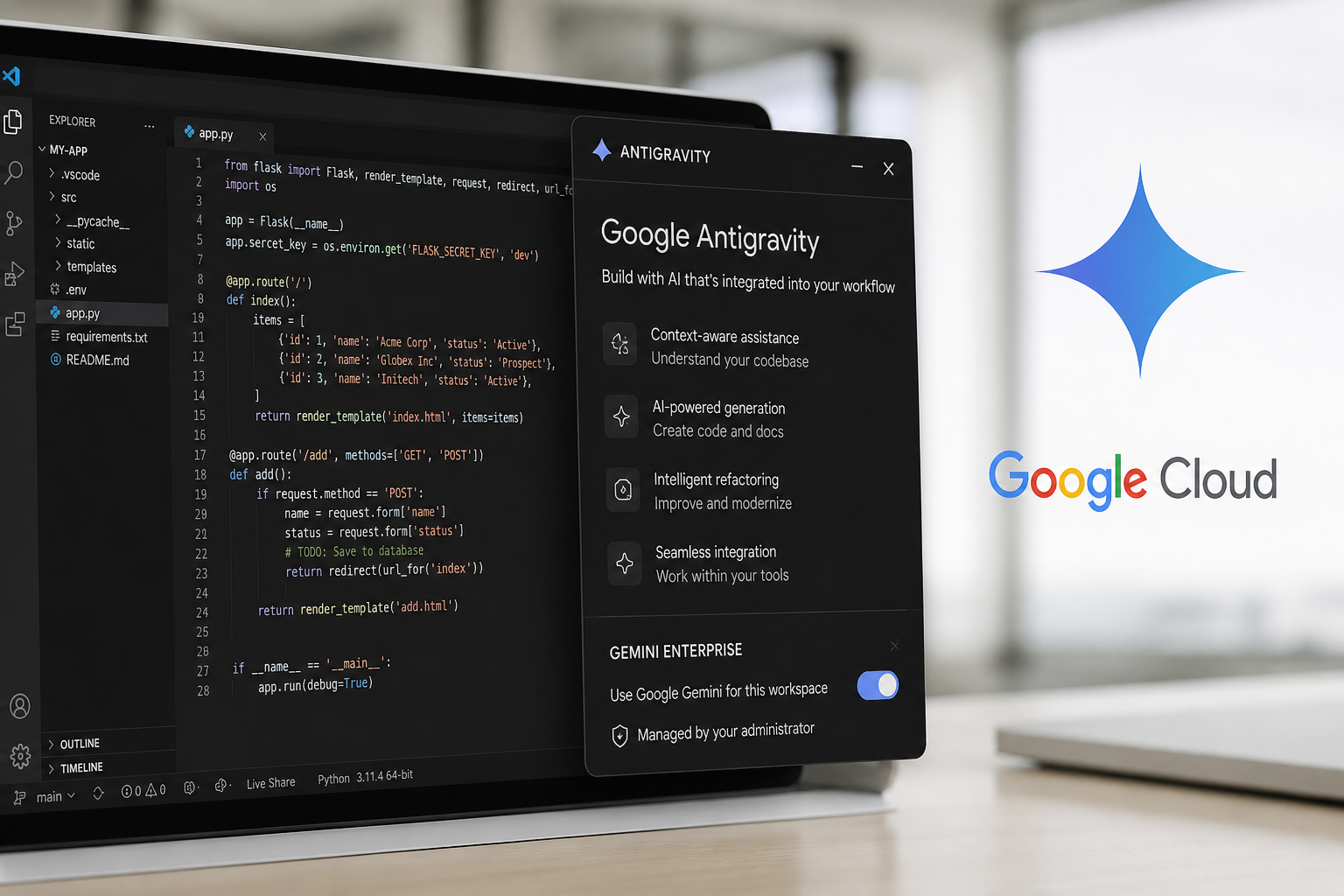
Google Cloud said on 20 August 2026 that Google Antigravity is now part of eligible Gemini Enterprise app subscriptions — Standard, Plus, and Standard Emerging Market — with administrative and spend controls included.
Scott Densmore, Senior Director of Engineering, and Damith Karunaratne, Group Product Manager, wrote the Cloud Blog. Google first announced Antigravity in the Gemini Enterprise Agent Platform at I/O in May. This drop is the bundling: one subscription instead of a separate add-on license, invoice, and security console.
How Google Antigravity is enabled and billed
Admins enable Antigravity and Android Studio from the Gemini Enterprise admin console for users on those eligible licenses. Broader support is “coming soon,” Google says. Do not assume every Gemini Enterprise SKU is in unless your console shows the toggle.
Spend controls are the other half of the pitch. Quotas are pooled so prepaid tokens are not stranded on idle teams. Administrators can set monthly project-level budget caps in the Billing console. Optional overages, if the admin opts in, move excess usage to standard consumption rates under those monthly caps. Per-user and team controls are scheduled later this year — Google’s words, not a date you can put in a runbook yet.
Usage metrics in the same console cover token consumption, API calls, and developer activity. Treat those as vendor telemetry. Log your own successful-task cost if you are writing agent skills against the pooled pool.
IDEs, identity, and the data-boundary claim
New IDE extensions put the agent in Visual Studio Code, plus Visual Studio, JetBrains, and Zed in preview, alongside the Antigravity 2.0 desktop app and the Antigravity CLI. Identity is Workforce Identity Federation (WIF) and Application Default Credentials (ADC), so engineers use existing enterprise login instead of minting API keys.
Google says sessions sit under Google Cloud Terms of Service and that agent activity executes inside the customer’s secure cloud boundary. The Antigravity blog also says customer code is not used to train base models. Those are vendor claims. Keep them in the skill as “Google-stated,” not as a legal opinion.
Admins can enforce workspace sandboxing, restrict browser and MCP server access, and turn on central audit logging that captures prompts, agent responses, and metadata. If you cannot see the log, do not let the agent run terminal commands on a production repo.
What customers actually said
AirAsia CTO Nikunj Shanti said the group is putting Gemini models into daily workflows with Antigravity 2.0 across engineering and back-office teams. Accenture’s Chetna Sehgal, Global Practice Lead for the Accenture Google Business Group, said the point is that teams should not have to choose between developer speed and enterprise-grade governance.
Google also quotes CGI, Cognizant, Datamatics, Deloitte, and Wipro. Read those as customer blurbs on a launch post, not as independent audits. The Antigravity blog separately says AirAsia teams now generate over 50% of their production QA code with Antigravity — a vendor-hosted customer figure. Flag it.
If you already defaulted coding agents to Gemini 3.7 Flash, pin the model ID inside Antigravity the same way you pin it in API skills. Defaults move. Wrap a code review skill on a pull request with the new sandbox and audit toggle, then turn a good chat into a reusable skill so the pooled quota is spent on a named job, not an open-ended session.
Practical takeaways
- Enable Antigravity only on Standard, Plus, and Standard Emerging Market until Google lists more SKUs.
- Set the project budget cap before you opt into overages.
- Preview IDEs (Visual Studio, JetBrains, Zed) are preview. Pin VS Code or the 2.0 app for production loops.
- Treat “data stays in your cloud boundary” as Google-stated. Keep a human on merge.
Sources
- Expanding Google Antigravity for enterprise customers — Google Cloud Blog, 20 August 2026
- Bringing Antigravity to Gemini Enterprise — Google Antigravity Blog