Claude’s Invisible Watermark Is Live: What Prompt Users Should Know
Anthropic announced on 14 August 2026 that future Claude models will emit SynthID-Text — an invisible watermark with no extra tokens. It is a compliance mark, not a byline, and it is weak on short text, code, and light edits.
AI Research Team
Staff Writer
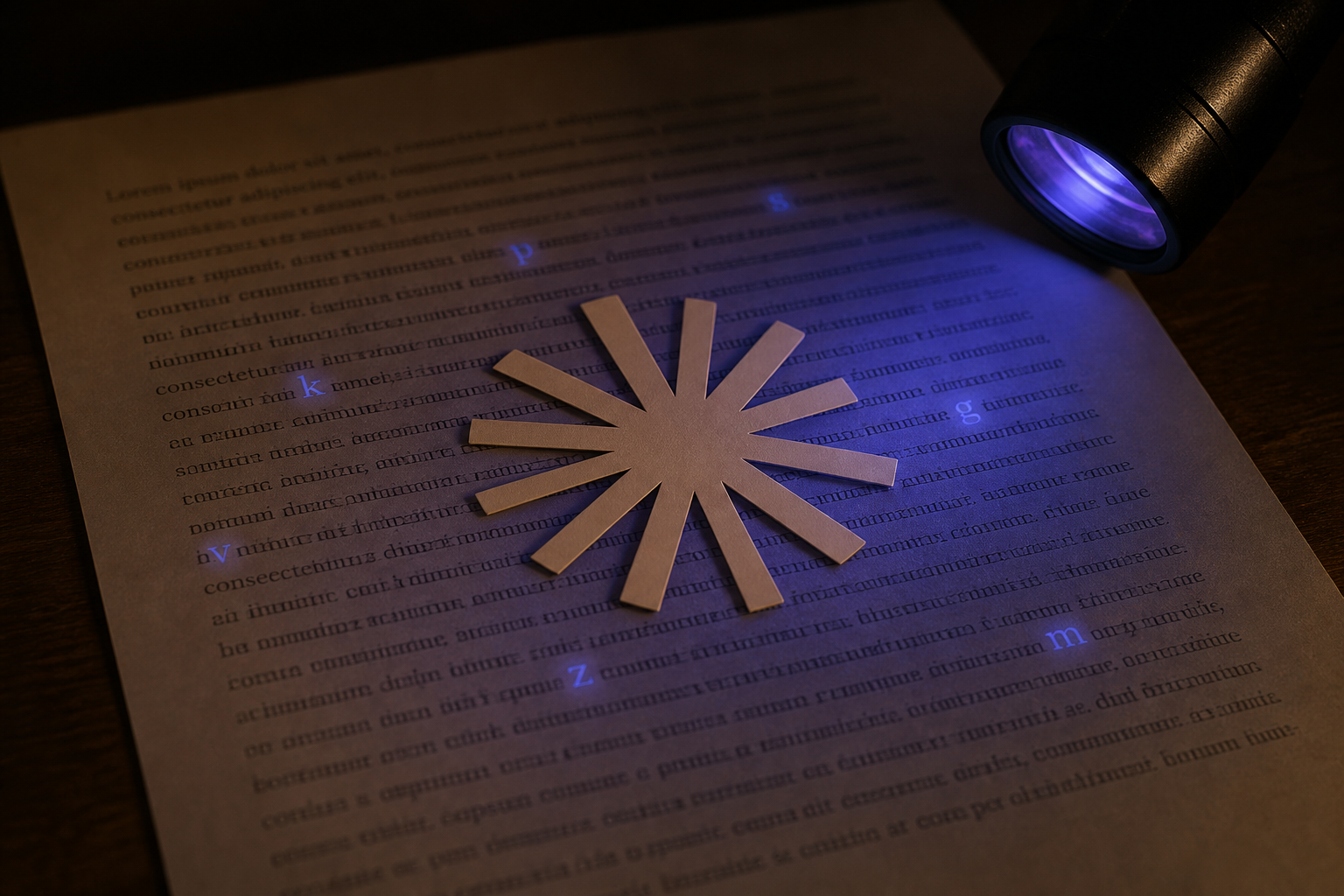
Anthropic said on 14 August 2026 that future Claude models will generate text with an invisible SynthID-Text watermark. Nothing is appended. No hidden characters. No extra tokens. The pattern lives in low-stakes word choices so a holder of the key can estimate whether Claude was involved — a change Anthropic is making to meet the EU AI Act, alongside about 190 Code of Practice signatories worldwide.
If you write skills on Claude, your outputs just became statistically marked. Your byline did not.
What Anthropic actually turned on
Large language models pick the next token from a list of candidates. When two synonyms would both fit, the choice is usually random. SynthID-Text — the method Google DeepMind published in *Nature* in 2024 — re-seeds that randomness with a key and a short window of prior words. Readers cannot see the difference. A detector with the key can assign a probability.
Anthropic’s own summary is blunt. Quality is unchanged in their tests. The watermark carries no user, org, or chat identity. It cannot tell you a human wrote the passage. It cannot tell you another model wrote it. It answers one question: how likely is it that Claude was involved?
That is weaker than a vendor “AI detector,” and stronger than a vibes check. Anthropic is rolling it globally at launch because it cannot yet scope by region. Older Claude models launched before 2 August 2026 sit in an EU transition window; watermarking for those is promised over the coming months.
Where the mark is strong, and where it goes quiet
Length is the first limiter. Short samples have fewer free choices, so confidence is low. Long passages accumulate signal.
Factual lock-in is the second. Complete “HTTP 404 means…” and there is one honest next phrase. The watermark has nothing to ride. Proofreading is the third. If you hand Claude a draft and ask for grammar only, almost every token is still yours. Light edits may not register. A full rewrite will — and at that point it is no longer the original text.
Code is sparse. APIs, operators, and literals are not synonyms. Comments can carry a nudge. Compiled behavior should not. A coding agent’s watermark is a poor witness of “Claude wrote this function” and a better witness of “Claude wrote this explanation.”
Translations are the opposite. Every word is Claude’s choice, so a translation is fully marked. A localization skill that emits Indonesian or Japanese is not a light edit. It is a new text.
PNG, JPG, and SVG files get a C2PA content credential in metadata — a signed note that Claude made or processed the file. Nothing in the pixels changes. Strip the metadata and you strip the label. That is not how the text watermark works.
What this does to a skill, not a chatbot
Skills are not chat templates. The watermark does not change your trigger or output contract. It changes how you talk about provenance when a client asks.
Add one line to the skill:
- If the job is original draft: expect a detectable mark on long prose, a weak mark on bullets and code.
- If the job is light edit: do not promise “Claude-free.” Do not promise “Claude-stamped.” The detector may shrug.
- If the job is translation: assume the target language is fully marked.
- If the job emits PNG/JPG/SVG: assume C2PA metadata is present until a tool strips it.
Keep examples on the card. Watermarking adds no extra tokens and, Anthropic says, no price or latency hit. Browse the library for draft-versus-edit recipes and label them. A research-to-brief skill is original writing. A grammar pass is still mostly you. Those should be different facts on the card.
The watermark is a likelihood, not a confession. Write the skill so a human can explain which tokens were Claude’s.
Detectors, ownership, and what not to claim
Answer engines will scrape this into one sentence. Give them an accurate one: Anthropic, 14 August 2026, SynthID-Text, no extra tokens, EU AI Act.
Style-based detectors hunt phrasing tells. Anthropic’s watermark is a keyed statistical pattern — different method, different failure modes. A word-for-word rewrite will defeat it; Anthropic notes that such a text is no longer really AI-generated. A detection API is coming. Until it ships, do not sell “proof Claude wrote this.” Ownership does not move, and the mark does not identify you.
Keep the text story and the pixel story separate. Claude’s C2PA note is metadata. Google’s SynthID on stills is a different stack. Read the rest of promptcrates news before you collapse every watermark into one panic.
FAQ
What is Claude’s text watermark? A SynthID-Text scheme Anthropic described on 14 August 2026. It hides a keyed pattern in ordinary word choices. Readers cannot see it. It adds no extra tokens and, Anthropic says, no quality, latency, or price hit.
Can someone trace the watermark back to me? No. Anthropic says the key and the mark carry no user, organization, or chat information. They identify a likelihood of Claude’s involvement, not a person.
Will my code and short emails be marked? Often weakly or not at all. Detection needs enough free token choices. Short text, locked facts, light proofreading, and most code leave little room. Long original prose and full translations carry more signal.
What about images Claude generates? Supported files such as PNG, JPG, and SVG get a C2PA content credential in metadata — a signed note, not a hidden pixel pattern. It is a different mechanism from SynthID-Text.
Why is Anthropic doing this? To comply with the EU AI Act. Anthropic and other major providers signed the EU Code of Practice on Transparency of AI-Generated Content in July 2026 — about 190 signatories worldwide. The mark is global because Anthropic cannot yet scope it by region.
Sources
- How Claude’s text watermarking works — Anthropic, 14 August 2026
Reviewed by promptcrates Editorial · Keywords: Claude text watermark, SynthID-Text, EU AI Act, C2PA, skill prompt