Korea BCMCC Starts Nationwide Deepfake Ethics Classes
South Korea’s Broadcasting and Media Communications Commission began nationwide media ethics education for high school students on 4 September 2026, focusing on deepfakes, hate speech, and mock broadcast reviews.
PromptCrates Editorial
Staff Writer
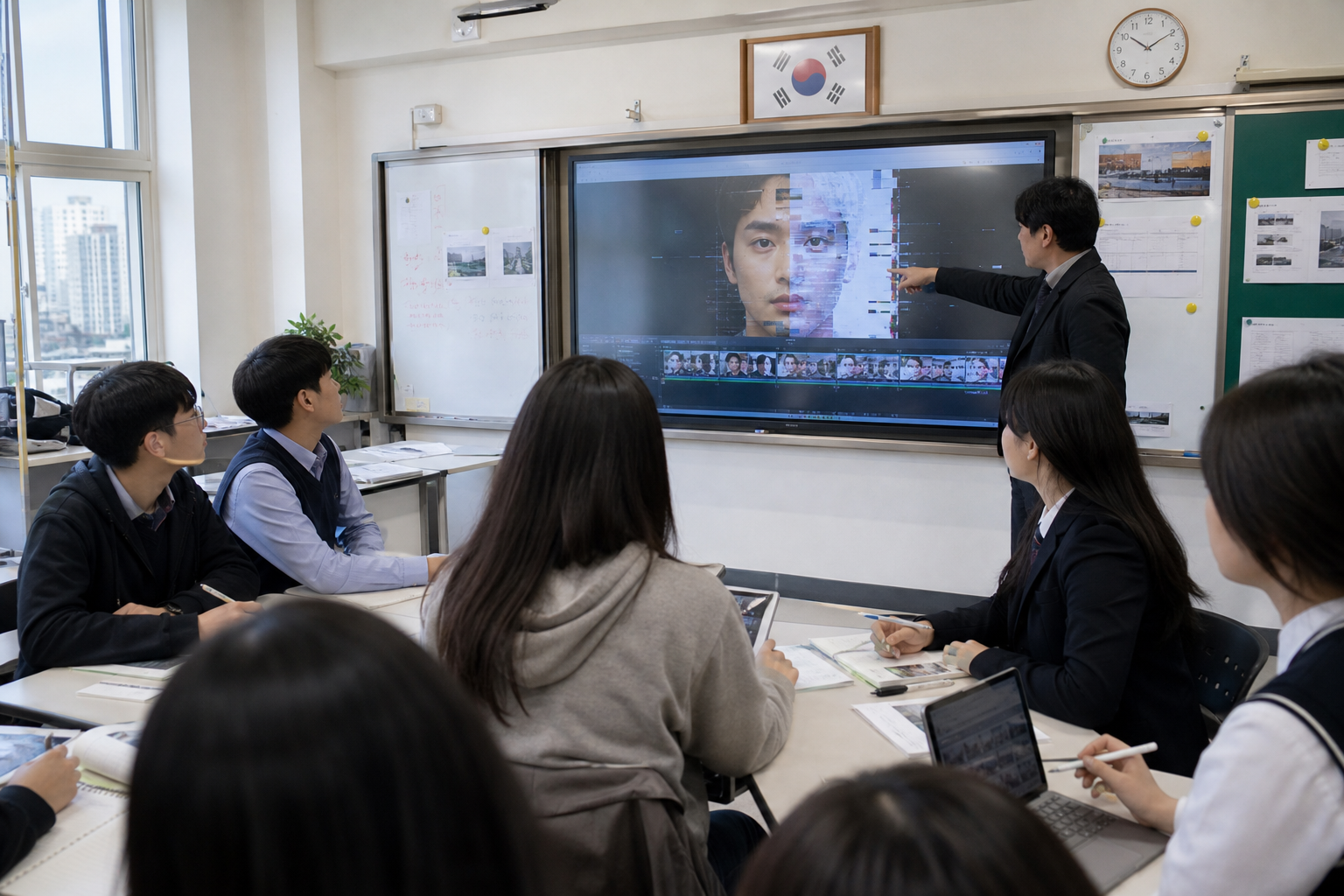
South Korea’s Broadcasting and Media Communications Commission began a nationwide media ethics education program for prospective creators on 4 September 2026, according to Digital Today’s report. High schools recommended by education offices in six MoU regions — Gangwon, Chungbuk, Daegu, Gwangju, Gyeongbuk, and Daejeon — plus nationwide schools that applied in advance will send students through modules on media ethics, broadcast and telecom review rules, and mock reviews that include sexual deepfakes and hate-speech cases.
How the six region MoUs expand reach
BCMCC is not inventing youth media literacy from scratch. The commission has run media ethics education for young people since 2015. What is new is the framing around prospective creators and the explicit pairing of deepfake and hate-speech response training with hands-on mock review of broadcasting and telecommunications rules. By signing business agreements with six regional education offices and also accepting advance nationwide applicants, the program tries to avoid a capital-city-only pilot while still using MoUs as an on-ramp for curriculum partners.
That structure matters for educators watching generative media move faster than classroom policy. Students who already edit short video, train voice clones, or remix faces need procedural literacy — what constitutes illegal or harmful information under review rules — not only abstract lectures about being kind online. Mock review sessions give a rehearsal space before a real complaint lands. Compare the governance tone with U.S. school-system AI staff guidance in DC OSSE staff AI model policy, where adult employees rather than student creators were the first control surface.
Why deepfakes push ethics into classrooms
Sexual deepfakes and discriminatory hate expressions are named case types in the BCMCC curriculum. That specificity tracks a global shift from generic digital citizenship slides toward scenario drills on non-consensual synthetic media. High school cohorts are both targets and potential distributors of such content. Teaching review procedures is a way to make platform and regulator language legible before students become professional creators in entertainment, gaming, or influencer economies.
Parents and principals should still ask hard questions the launch note leaves open. How many instructional hours does each school receive? Are materials available in multiple languages for multicultural classrooms? How will success be measured — attendance, pre/post quizzes, or reduction in reported incidents? Without those metrics, nationwide branding can outrun classroom reality. Still, naming deepfakes inside an official MoU-backed course is a clearer signal than voluntary after-school clubs alone.
- Program start dated 4 September 2026 for prospective creators
- Six MoU regions: Gangwon, Chungbuk, Daegu, Gwangju, Gyeongbuk, Daejeon
- Nationwide advance applicants also eligible
- Modules cover ethics, review rules, violation cases, and mock reviews
- Youth media ethics education lineage dating to 2015
What other systems can learn from BCMCC
Education ministries elsewhere often separate AI literacy from media regulation. BCMCC’s approach collapses them: the same students who will publish to broadcast-adjacent platforms learn the review vocabulary regulators use. That may not transfer one-to-one to countries without a comparable commission, but the pattern — MoUs with regional education offices, mock adjudication, explicit deepfake casework — is portable. Districts drafting synthetic-media units can borrow the structure even if statutes differ.
Creative-industry pipelines should also pay attention. If Korea’s next cohort of creators graduates with shared language about hate speech and non-consensual deepfakes, platforms hiring in Seoul may face higher baseline expectations for content moderation literacy. Publicity and synthetic-media legal fights covered in Jason Isbell Suno publicity lawsuit sit upstream of classroom ethics; BCMCC sits downstream where teens decide whether a remix is funny, harmful, or illegal. Policy stacks need both layers.
For international observers, the story is less about a single syllabus PDF and more about state capacity. A regulator that has taught youth media ethics for a decade is now updating that franchise for generative deepfakes instead of waiting for a brand-new agency. Expansion through education-office MoUs is incremental, not flashy, which is often how durable curriculum change actually sticks. Watch whether BCMCC publishes anonymized case packs other countries can localize — that would turn a national program into a reusable teaching asset for media classrooms worldwide.
Teachers implementing the modules should budget time for student-made examples that feel closer to TikTok than textbook hypotheticals. A mock review that only uses outdated celebrity rumor cases will fail to engage cohorts who already see face-swap apps on their phones. Pairing BCMCC review vocabulary with local, age-appropriate scenarios — without circulating harmful material — is the hard classroom craft that will decide whether nationwide branding becomes genuine literacy or a one-day assembly.
Civil society groups tracking teen digital harm should press BCMCC for public evaluation reports after the first semester. Transparent metrics would let other Asian education systems decide whether MoU-backed mock reviews outperform ad-hoc workshops. Without published outcomes, the program risks becoming a press-cycle announcement rather than a measured intervention against deepfake abuse in schools.
Sources
- BCMCC to provide training for high school students nationwide on responding to deepfakes and hate speech — Digital Today, updated 4 September 2026