D.C. OSSE Issues Stoplight Staff AI Model Policy
On 1 September 2026 the District of Columbia’s OSSE released a 2026–27 AI Model Policy for Staff Use that sorts employee AI tasks into red, yellow, and green risk bands after finding only 45% of local education agencies had staff AI policies in February.
PromptCrates Editorial
Staff Writer
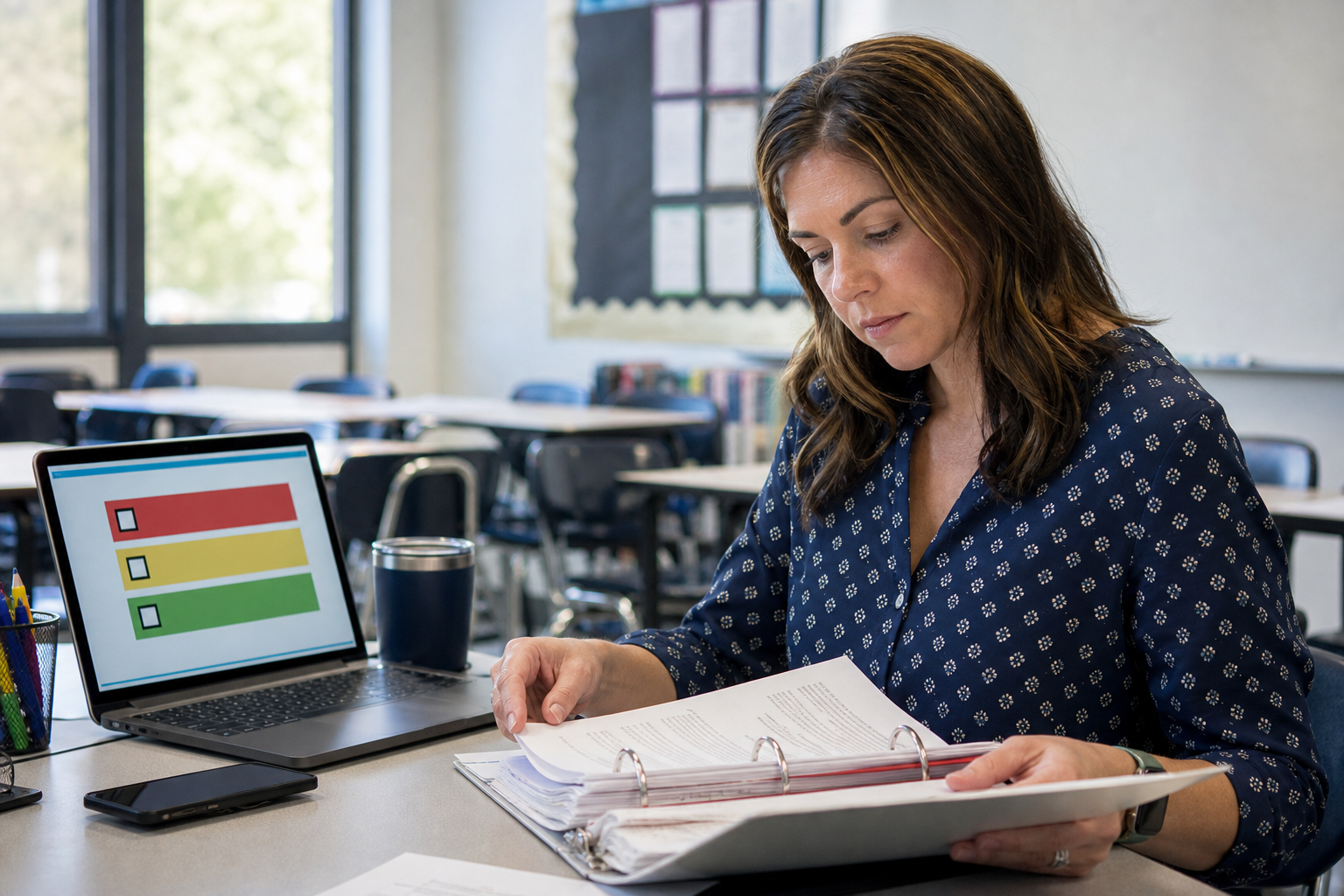
The District of Columbia’s Office of the State Superintendent of Education released its first AI Model Policy for Staff Use on 1 September 2026 for the 2026–27 school year, using a red-yellow-green stoplight to separate prohibited, restricted, and lower-risk employee AI uses. TechEd Magazine’s 2 September coverage noted that a February 2026 survey found only 45% of D.C. local education agencies already had staff AI policies — the gap the model aims to close.
Red bans for high-stakes school decisions
According to TechEd Magazine’s OSSE policy report, the red zone blocks AI from making high-stakes decisions that require human professional judgment. Explicit examples include physical surveillance of students or employees, student disciplinary decisions, teacher-performance evaluations, and determining eligibility for individualized education programs or Section 504 accommodations.
The design separates analytical speed from institutional authority. An algorithm might summarize attendance or behavior notes, but discipline still needs context about disability, climate, credibility, and proportionality. Teacher evaluation similarly resists collapsing classroom complexity into an automated score. Special education gets a bright line: eligibility stays human even when paperwork feels automatable.
Yellow safeguards and green classroom help
Yellow covers valuable but consequential assistance: monitoring activity on district-issued devices, drafting IEP language, reviewing or grading student work, and supplemental coaching for educators. Those tasks can improve productivity, yet errors can harm students, so OSSE expects extra safeguards and unbroken human oversight. Green lists lower-risk productivity work — lesson plans, instructional materials, tutoring plans, data analysis, school communications, and logistics — still with a professional in the loop.
- Red: discipline, teacher eval, IEP/504 eligibility, physical surveillance
- Yellow: grading assist, draft IEP language, device monitoring with safeguards
- Green: lesson plans, communications, data analysis with human review
- Guidance for LEAs — not binding law; student use not covered
- Recommend approved enterprise tools plus annual AI literacy
OSSE recommends approved enterprise AI systems especially when personally identifiable information is involved, pointing staff to FERPA, COPPA, CIPA, IDEA, HIPAA where applicable, and District student digital-privacy rules. Consumer chatbots may be free and convenient, but a prompt that pastes intervention notes into an unvetted tool can become a privacy incident overnight. AI governance here is also cybersecurity and procurement governance.
Survey gap and literacy expectations
State Superintendent Dr. Antoinette S. Mitchell framed the goal as practical guardrails that keep human judgment central while strengthening privacy protections. The February survey’s 45% figure showed policy lagging classroom experimentation. OSSE presents the stoplight as customizable guidance, not legal advice, and states that student AI use and full procurement strategy sit outside this document’s scope — districts still need those layers separately.
Training is part of the package: robust preparation before staff use AI, demonstrated AI literacy, and annual renewal. OSSE also planned professional-development courses such as AI Literacy for Educators and Instructional Decision-Making and AI Dilemmas. Readers tracking how platforms get labeled and governed at larger scales can compare education stoplights with regulatory framing in EU DSA ChatGPT very large search engine and frontier oversight questions in EU AI Office first RFIs to frontier labs.
For superintendents outside D.C., the portable lesson is process, not copy-paste language. Inventory real staff AI uses first. Classify by consequence rather than by brand name. Forbid outsourcing of high-stakes human decisions. Require approved tools for student data. Fund literacy so employees can spot hallucinations, bias, and retention risks. Creative classrooms experimenting with image tools may also watch product shifts such as Midjourney v8.2 Edit Lightbox alpha, but classroom policy should still ask how much consequence a machine is being given.
File this as education news for the 2026–27 year: a voluntary stoplight model from OSSE, a documented 45% policy gap, clear red lines around discipline and special-education eligibility, and an explicit reminder that staff rules are not the same as student-use rules. The products will keep changing; the consequence test can travel with educators.
The yellow zone may prove hardest to implement because it covers everyday workflows. A teacher using AI to draft feedback still owns accuracy; a case manager using AI to draft IEP language still owns legal sufficiency. Districts that only publish a color chart without audit samples, parent notice practices, and vendor inventories will recreate the same uneven compliance the survey already found.
Privacy counsel should pay special attention to device-monitoring tools listed under yellow. Surveillance-adjacent features can slide from network safety into continuous behavioral scoring if left undefined. OSSE’s red ban on physical surveillance sets a ceiling; local policies must still define what telemetry from school devices is collected, retained, and reviewed.
Other states watching D.C. will likely copy the stoplight metaphor even if they rewrite the examples. The durable export is the consequence test: ask how much institutional authority is being delegated before asking which chatbot brand is fashionable this semester. Staff policy remains incomplete without student-use rules, but it is a necessary first layer as generative features appear inside tools schools already bought.
Sources
- D.C. Releases School AI Policy as Districts Move From Experimentation to Formal Guardrails — TechEd Magazine, 2 September 2026