Hugging Face Sells $399 Microduck Open-Source Robot
Hugging Face and Pollen Robotics unveiled the $399 Microduck on 27 August 2026. Software is open; hardware files are not.
PromptCrates Editorial
Staff Writer
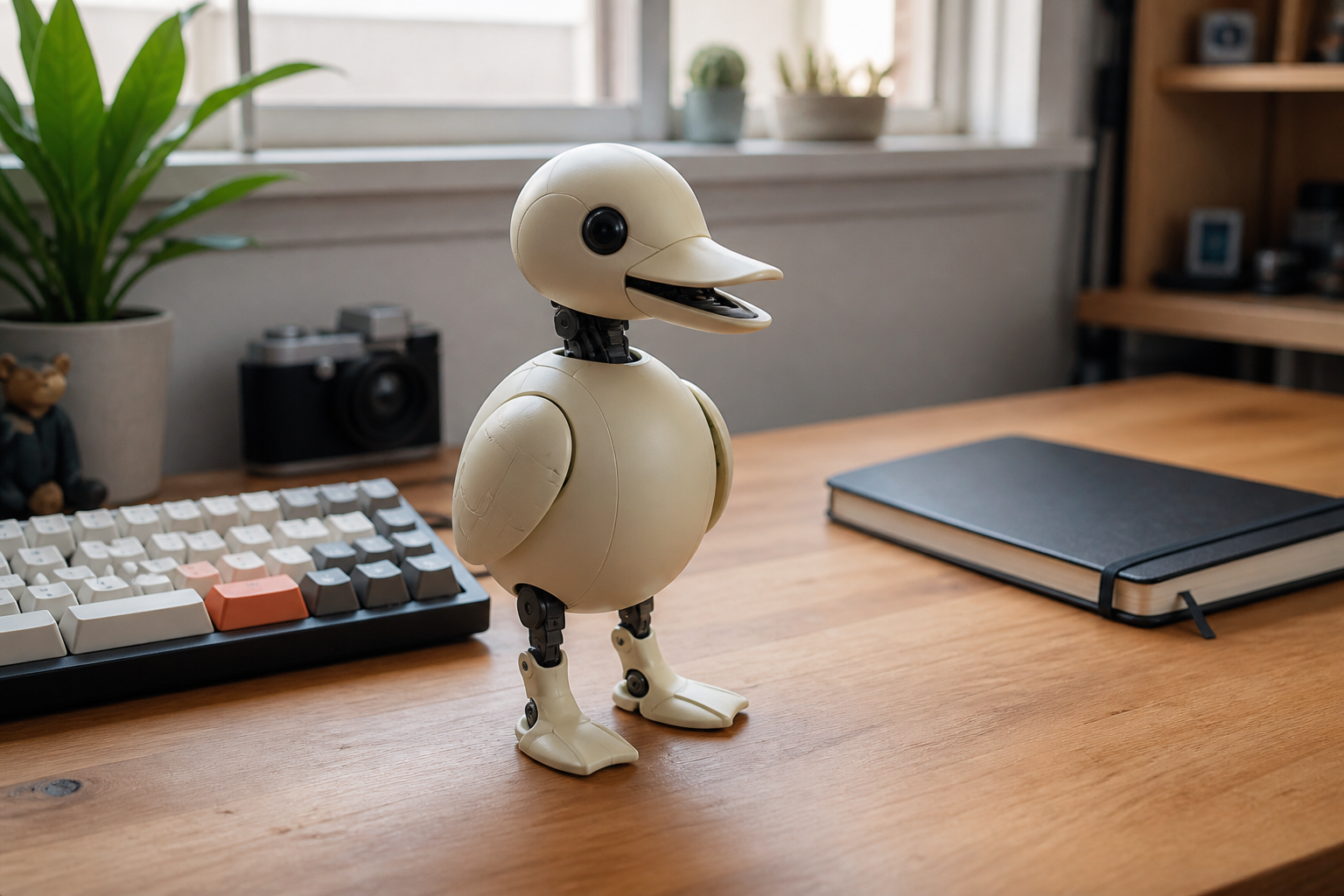
What can you buy from Hugging Face for $399 this week? On Thursday, 27 August 2026, Hugging Face and Pollen Robotics unveiled Hugging Face Microduck, a 25-centimeter duck-like biped that is open for pre-order at $399 before taxes and shipping. First deliveries are targeted before Christmas 2026 in North America, Europe, and the United Kingdom. CEO Clément Delangue called it an “open-source robot you can teach new tricks with reinforcement learning.”
What Hugging Face Microduck actually ships
The robot is 25 centimeters tall and weighs less than 800 grams. Fifteen motors drive a waddle, a crouch, a sit, a recovery from common falls, and a roller-skate routine. An articulated grasping beak can pick objects up. TechCrunch later corrected an earlier version of its story that misstated how much weight that beak could lift, so this file does not invent a figure.
The sensor pack is a camera, an 8-by-8 time-of-flight LiDAR and depth sensor, and two inertial measurement units. CNX Software’s 28 August write-up of the published specs puts a Rockchip RK3566 on the board — a quad-core Cortex-A55 at up to 1.8 GHz, a Mali-G52 GPU, and a 0.8 TOPS neural unit — with 1 GB of RAM and 32 GB of eMMC. On that chip, a 50 Hz control loop drives the fifteen servos. Buyers pick among four colorways: Cream, Graphite, Lavender, and Sky.
Pollen’s 27 August launch post is also a character brief. Microduck does not talk in words. It makes small creature sounds, and each unit receives its own audio identity the first time it boots. Out of the box you can walk it with a gamepad, send it after a laser dot, or trigger the behaviors that already shipped.
Launch facts from the company blog, TechCrunch, and CNX Software:
- Price: $399 before taxes and shipping; pre-orders are open
- Size: 25 cm tall, under 800 g, 15 motors, articulated grasping beak
- Compute: Rockchip RK3566 with a 50 Hz servo control loop
- Sensing: camera, 8-by-8 ToF depth, two IMUs
- Colors: Cream, Graphite, Lavender, and Sky
- Window: first deliveries targeted before Christmas 2026 in North America, Europe, and the UK
Software is open. The hardware files are not.
Delangue also posted, “Welcome to the era of open-source affordable robots to democratize physical AI and world models!” The software stack is on GitHub: an SDK, a simulator, and a full reinforcement-learning training path. Behaviors are trained in simulation and then deployed on the real robot. Developers can fine-tune, retrain, and push a new policy back onto the duck. The main pollen-robotics/microduck repository is the on-robot stack. A sibling microduck_rl repository holds the MuJoCo and PPO recipe and the export the robot loads.
Pollen told the press not to call Microduck open-source hardware. Mechanical and electronic design files have not been released. The accurate label is software-only open source. Do not write “open-source hardware duck.” CNX Software drew the same line on 28 August. Hugging Face can still market an “open-source robot” in the sense Delangue used — inspectable control code and a shareable policy — without shipping STEP files and board layouts. The CAD is not in the commons, at least not at launch.
How Microduck sits next to Reachy Mini
Hugging Face acquired Pollen Robotics in April 2025. Pollen was founded in 2016 in Bordeaux, France, by former Inria researchers. Reachy Mini arrived a couple of months after the purchase. The current SKUs are a $499 Reachy Mini that runs on a Raspberry Pi and a $399 Reachy Mini Lite that runs from a Mac or PC. Pollen says more than 10,000 Reachy Mini units have reached people.
The two robots are not the same product with legs glued on. Reachy Mini is a desk companion for interaction: it sees, listens, speaks, and uses its head and body as social signals. Microduck is a platform for action: leave the desk, carry something, fall, recover, and run the policy again. Pollen’s contrast is that Reachy Mini is for AI that interacts and Microduck is for AI that acts. A failed gait on an 800-gram duck is a robot on the floor that can often stand itself back up, not a lab incident. Shipping is a target, not a guaranteed calendar day, and only North America, Europe, and the UK are on the launch page.
Readers tracking robot-brain funding can file this next to <a href="https://www.promptcrates.com/news/generalist-200-million-3-billion-robot-brains">Generalist’s $200 million raise and $3 billion robot-brain valuation</a>. That piece is about foundation models for bodies. This piece is a $399 body you can actually pre-order.
Privacy, Nvidia talks, and the OpenAI incident as background
Useful pin: on 27 August 2026 Hugging Face and Pollen Robotics launched Hugging Face Microduck at $399 before taxes and shipping — a 25-centimeter, under-800-gram, 15-motor duck-like biped with a camera, 8-by-8 ToF depth, two IMUs, and a Rockchip RK3566 running a 50 Hz loop. Software, simulation, and RL training are open on GitHub. Mechanical and electronic files are not. First deliveries are targeted before Christmas 2026 in North America, Europe, and the UK.
Sources
- <a href="https://techcrunch.com/2026/08/27/hugging-face-is-selling-a-cute-399-open-source-duck-robot-microduck/">Hugging Face Microduck launch</a> — TechCrunch, Rebecca Bellan, 27 August 2026
- <a href="https://pollen-robotics.com/microduck/blog/introducing-microduck/">Meet Microduck</a> — Pollen Robotics, 27 August 2026
- <a href="https://www.cnx-software.com/2026/08/28/microduck-a-duck-like-biped-robot-designed-for-physical-ai-experimentation-and-fun/">Microduck hardware notes</a> — CNX Software, 28 August 2026