
NVIDIA Opens NV-Reason-CT for 3D Radiology Reasoning
NVIDIA released NV-Reason-CT on 23 September 2026 as an open vision-language model that reads full 3D CT volumes and writes radiologist-style chain-of-thought reasoning instead of emitting labels alone.
PromptCrates Editorial
Staff Writer
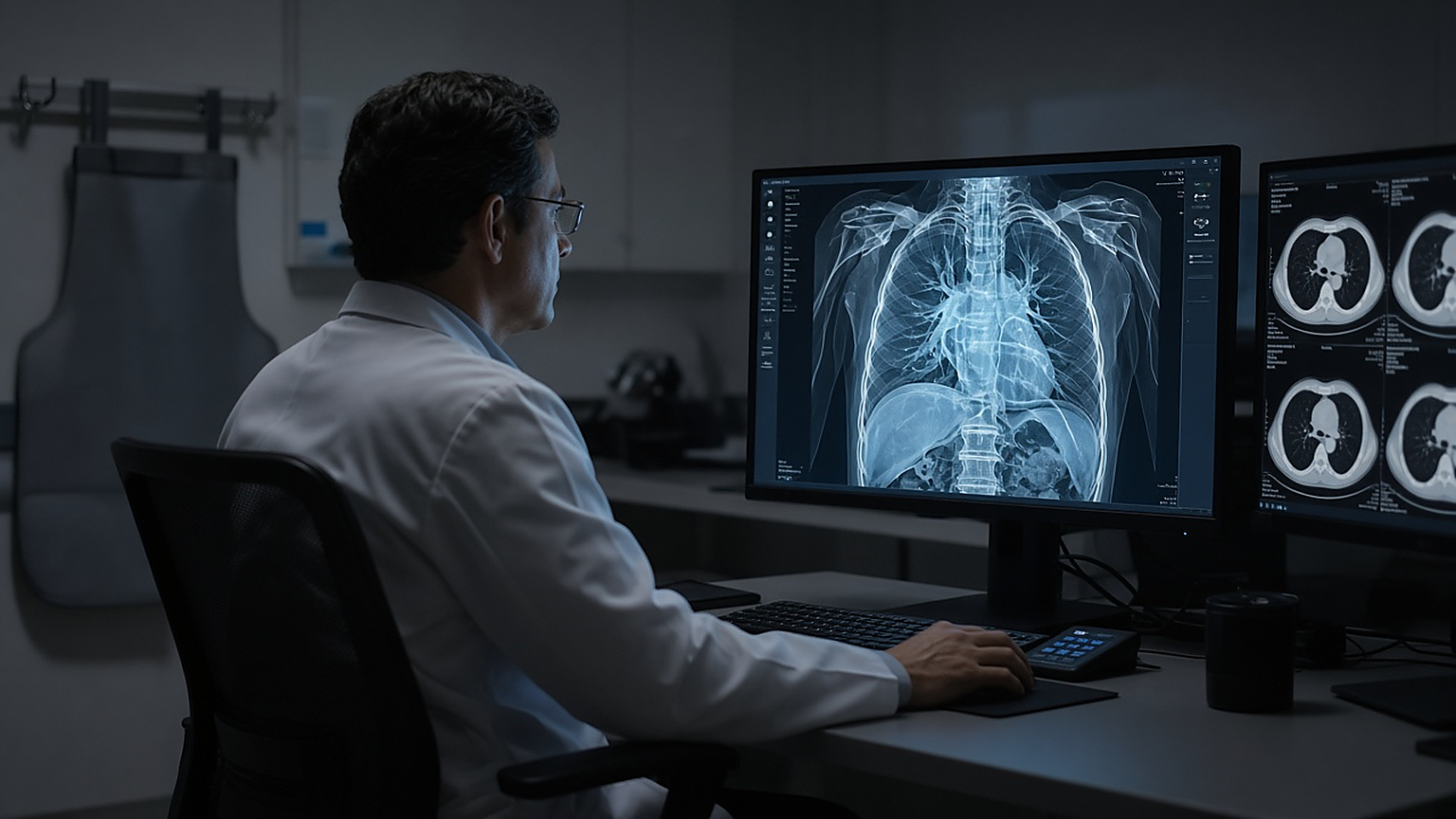
NVIDIA released NV-Reason-CT on 23 September 2026 as an open vision-language model that reads full 3D CT volumes and writes radiologist-style chain-of-thought reasoning instead of emitting labels alone. On the CT-RATE benchmark the model reached a macro-F1 of 0.614 and a macro-AUROC of 0.871 without a task-specific classification head, according to NVIDIA’s technical blog and the accompanying arXiv paper. National Institutes of Health radiologists reviewed structured reports and reasoning traces and described them as clinically plausible, while a preliminary expert study associated AI-assisted review with about a 50 percent reduction in average reported interpretation and reporting time. NVIDIA positions the release as a research foundation for post-training, not as an autonomous diagnostic product or a cleared clinical device.
Why volumetric CT needed a different vision language design
A single abdominal CT study can span 300 to 600 axial slices. Standard vision-language models that flatten those slices into independent 2D frames discard through-plane relationships that define masses, effusions, and infiltrates. NVIDIA argues that frontier general-purpose models still perform poorly on volumetric imaging and that many open medical models lack the multistep conversational depth radiologists need before they will trust AI-generated findings. NV-Reason-CT answers with a native 3D vision transformer paired to a Qwen3.5-4B language model, passing all encoded visual tokens and their explicit 3D coordinates into language decoding without further spatial token merging.
The architecture processes volumes resampled to 192 cubed voxels at 2 mm isotropic resolution using non-overlapping 8 cubed patches, yielding a 24 by 24 by 24 grid of 13,824 vision tokens. Those tokens keep depth, height, and width indices through multimodal rotary positional encoding inside the language model, so laterality and craniocaudal extent remain addressable during joint image-text reasoning. Capabilities listed by NVIDIA include structured report generation guided by a curated ontology of 30 chest and 29 abdominal abnormalities, radiologist-emulating chain-of-thought, and multistep conversational follow-up across chest and abdomen. Training used roughly 550,000 multimodal instruction examples from about 70,111 unique CT inputs, combining expert narrations, synthetic report-grounded reasoning, VQA, and refusal examples, then refined with Group Relative Policy Optimization using anatomy-aware abnormality rewards.
What the benchmarks and clinicians actually showed
On CT-RATE, NV-Reason-CT outperformed published 3D contrastive and fused 2D/3D baselines in NVIDIA’s comparison table, including VoxelFM, Pillar-0, ClinFusion-8B, CT-CLIP, Merlin, and MedGemma 1.5 under the reported protocols. Generated reports reached a report-derived macro-F1 of 0.592 on NVIDIA’s evaluation. The company is careful to separate research scores from clinical clearance: the model is open for researchers and developers to post-train into specialized CT applications and to combine with complementary NVIDIA medical tools for segmentation and synthetic data generation, not to replace attending sign-out.
Clinical quotes in the NVIDIA blog underscore explainability as the adoption hinge. NIH senior clinician Baris Turkbey said step-by-step reasoning that reflects how radiologists think through a study is what makes it possible to trust and act on findings. That framing aligns with broader medical AI pressure after a summer of agent mishaps elsewhere in the industry; hospitals want audit trails more than leaderboard bragging rights. PromptCrates readers following NVIDIA’s larger platform moves can place this medical release beside coverage such as NVIDIA Hugging Face acquisition and Perplexity portable NVIDIA DGX Spark, which show how NVIDIA is wiring open models, developer distribution, and hardware into the same stack.
For health systems evaluating pilots, the practical checklist is narrower than the paper. Confirm whether weights and recipes match the GitHub and Hugging Face artifacts NVIDIA points to, whether institutional CT distributions require post-training before any prospective study, and whether liability policies treat chain-of-thought traces as documentation aids rather than diagnostic authority. The arXiv abstract’s 50 percent time-reduction figure comes from a preliminary expert study and should be replicated under local reading-room conditions before operations teams rewrite staffing models.
Hospitals piloting volumetric assistants should also budget for compute and DICOM-to-NIfTI preprocessing, because the public inference path expects regional crops rather than raw PACS hanging protocols. Teams that already run MONAI-based pipelines will find the preprocessing story familiar, while sites without 3D research infrastructure may prefer vendor-integrated post-training partners before exposing NV-Reason-CT outputs to clinical staff even in shadow mode.
Open research status and near-term use cases
NVIDIA lists research and medical-AI builder scenarios rather than overnight PACS replacement: studying chain-of-thought in volumetric imaging, fine-tuning on institution-specific CT datasets, and integrating structured CT reasoning into radiology review workflows. Complementary models named in the ecosystem include NV-Generate-CTMR, NV-Segment-CTMR, and the earlier NV-Reason-CXR chest X-ray reasoner validated in work accepted at RSNA 2026. Developers can start from the public blog walkthrough, Hugging Face checkpoints, and the NVIDIA-Medtech/NV-Reason-CT repository for inference and post-training recipes.
Documented facts stay tied to NVIDIA’s 23 September 2026 technical blog and arXiv:2609.27511: open 3D CT VLM with native 3D ViT plus Qwen3.5-4B; CT-RATE macro-F1 0.614 and macro-AUROC 0.871; report-derived macro-F1 0.592; ontology covering 30 chest and 29 abdominal abnormalities; about 550,000 instruction examples from 70,111 CT inputs; SFT then GRPO; NIH clinician review of plausibility; preliminary expert study noting roughly 50 percent time reduction; research foundation, not a cleared diagnostic product.
Primary sources: NVIDIA technical blog on NV-Reason-CT and arXiv:2609.27511.