
Nvidia AVO Hits 100% on ARC-AGI-3 by Wrapping Claude Opus 5
NVIDIA's 21 August 2026 technical blog says Agentic Variation Operators (AVO) with Claude Opus 5 scored 100.00 RHAE on the ARC-AGI-3 public set: 25 environments, 183 levels, 6,624 actions. Research demo, not a product. NVIDIA flags it as its measurement, not the private ARC Prize competition.
PromptCrates Editorial
Staff Writer
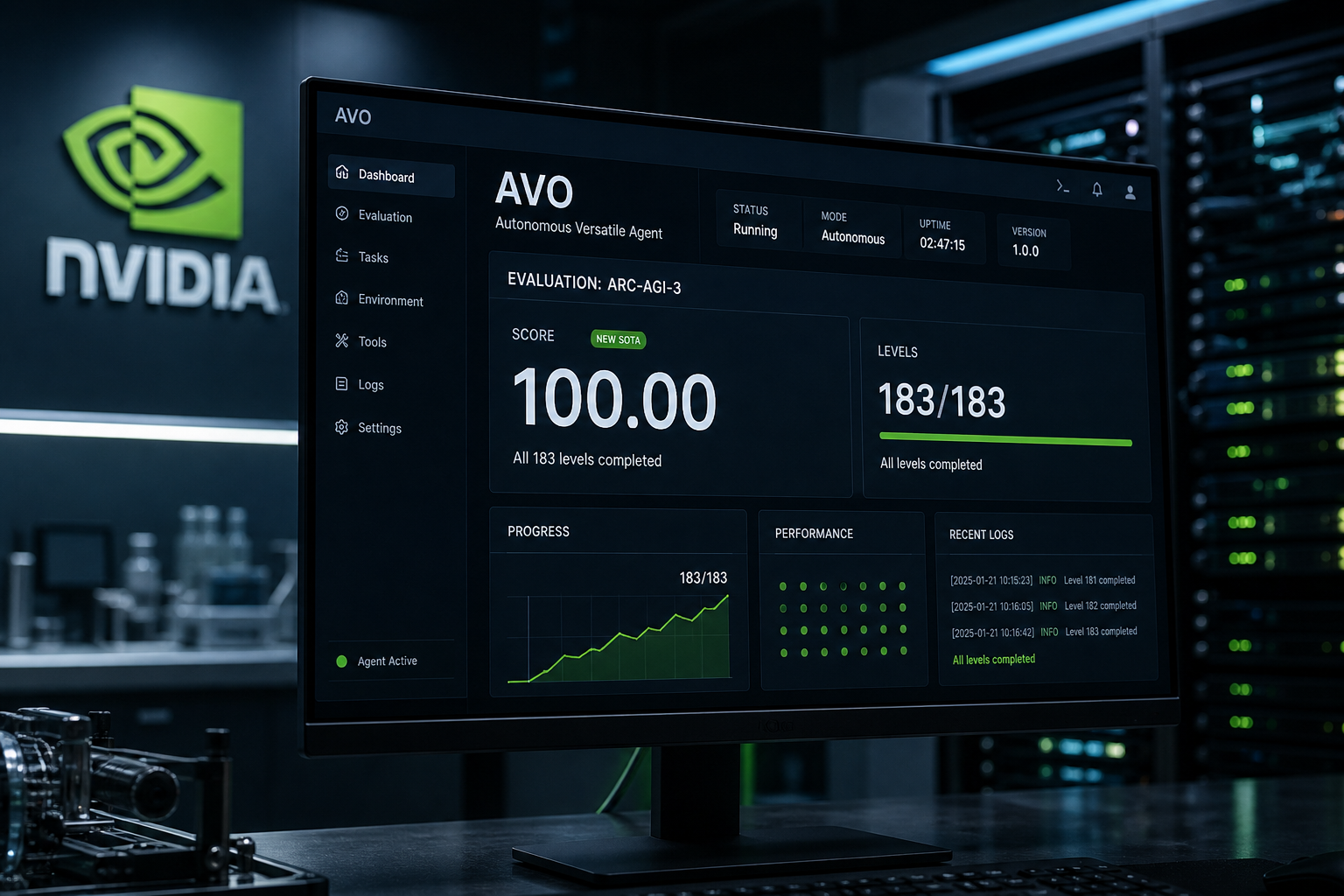
NVIDIA said on 21 August 2026 that Nvidia AVO — Agentic Variation Operators — wrapped Claude Opus 5 and scored 100.00 RHAE on the ARC-AGI-3 public set, finishing all 183 levels across 25 environments.
The figure is NVIDIA’s own measurement on the public environments. The write-up is a research demo, not a commercial product. NVIDIA flags that these are not results on the semi-private or fully private ARC Prize competition sets.
What Nvidia AVO actually measured
AVO is NVIDIA’s general-purpose coding-agent architecture. Persistent memory carries prior implementations, evals, and reasoning forward so the agent does not reconstruct the search every turn. A supervisor watches the broader trajectory and can redirect when progress stalls. The agent runs its own execution loop. That is the contrast NVIDIA draws with VISTA, which instantiates Claude Opus 5 through Claude Code or GPT-5.6 Sol through Codex.
On the public set, NVIDIA reports AVO with Claude Opus 5 used 6,624 environment actions. VISTA with Claude Opus 5, NVIDIA says, used 7,542 actions for the same 183 levels — about 12% more. NVIDIA is explicit this is not a controlled ablation: agent backend, observation format, memory, and context management all differ.
ARC Prize independently reports about 30% for Claude Opus 5 at high reasoning effort; Officechai cites a 30.2% standing model record. NVIDIA used the same model family under a different reasoning setting and a different agent system. Do not read 30% to 100.00 as a model leap. It is a system score. The model is one component.
NVIDIA also paired AVO with GPT-5.6 Sol on a challenging subset. In those limited runs, Sol reached matched levels faster in wall-clock time in some cases; Opus used fewer environment actions in matched-level comparisons. Complementary profiles, not a full public-set bake-off.
Why a public-set 100.00 is not a leaderboard trophy
ARC-AGI-3, from François Chollet’s ARC Prize Foundation, drops an agent into unfamiliar game-like environments with no instructions, stated rules, or stated goals. The agent must explore, infer what actions do, and spend those actions efficiently. Scoring is Relative Human Action Efficiency (RHAE): completion plus per-level efficiency against first-time human baselines.
Public environments get easier as they become familiar. That is why the competition keeps semi-private and private sets. NVIDIA says it reimplemented the task interface independently, informed by VISTA’s direct-interaction design rather than Tycho’s programmatic world models. AVO fed the model a text-only 64×64 grid — no images. VISTA’s primary configuration uses a rendered 512×512 PNG.
Read the 100.00 as NVIDIA-stated evidence that a harness with memory and supervision can extract more from an existing frontier model on this public set. Do not file it as an official ARC Prize private-set win.
Same loop on kernels, then games
NVIDIA first showed AVO on software engineering and GPU-kernel optimization. In an attention-kernel study, NVIDIA says AVO ran continuously for seven days, explored more than 500 directions, committed 40 kernel versions, and beat FlashAttention-4 by up to 10.5% on DGX B200 systems (and cuDNN by up to 3.5% in the evaluated configurations). Those are vendor numbers. File them as NVIDIA-stated, then wait for independent kernels.
The research claim is transfer: compilers and profilers in one domain, environment transitions in the other, same loop — hypothesize, act, observe, keep state, recover. If you are writing agent skills, copy the architecture, not the headline. A Skill prompt that only wraps a chat model will look like the ~30% baseline. The Cerebras CS-4 inference story is the hardware counterpart: throughput without a loop still is not an agent. And if your agent can act for days, treat OpenAI’s Astra cyber pause as the reminder that long-horizon tools need a deny list, not just a high RHAE.
Practical takeaways
- Treat 100.00 RHAE as NVIDIA’s public-set system score, not ARC Prize private-set gospel.
- Quote 6,624 versus 7,542 actions with the ablation caveat attached.
- Do not advertise Claude Opus 5 as a 100% ARC-AGI-3 model.
- If you copy the idea, copy memory plus supervision and a stop condition.
Sources
- NVIDIA AVO reaches 100% on ARC-AGI-3 — NVIDIA Technical Blog, 21 August 2026
- NVIDIA's coding agent AVO scores 100 on ARC-AGI — Officechai