Instinct Raises $250 Million Series B at $2.5 Billion
Instinct told the Wall Street Journal on 26 August 2026 that it raised a $250 million Series B co-led by Index Ventures and Benchmark. The round takes total funding to $350 million and values the private-beta life-organization agent at $2.5 billion.
PromptCrates Editorial
Staff Writer
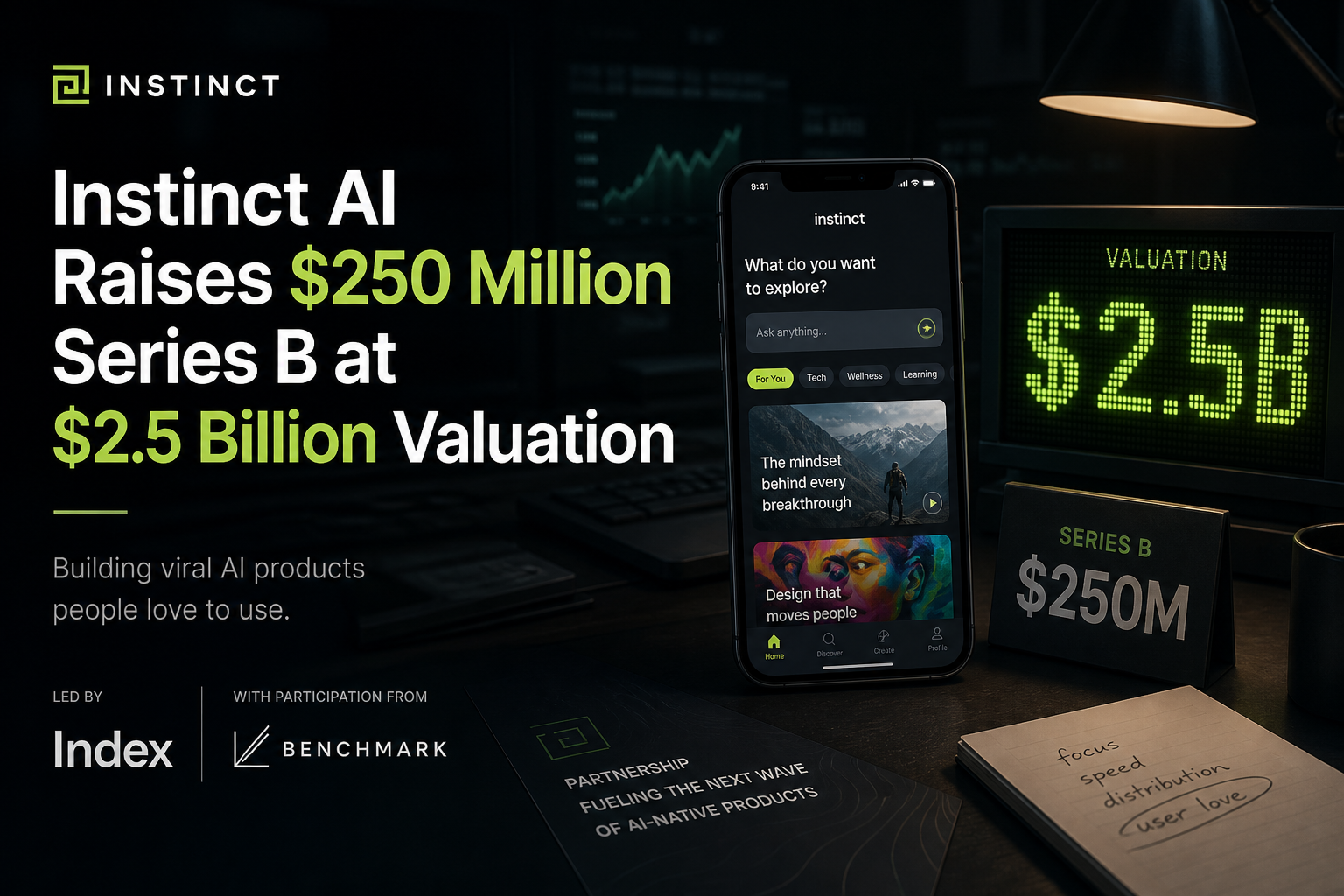
Instinct told the Wall Street Journal on 26 August 2026 that it raised a $250 million Series B co-led by Index Ventures and Benchmark. The round takes total funding to $350 million and puts a $2.5 billion valuation on a private-beta life-organization agent founded only last year.
Who put $250 million into Instinct's Series B
TechCrunch published the Journal's figures on 26 August 2026. The company is Instinct. The corporate wrapper is Spear Street Technology. The founder and CEO is Noah Shinn, who is 23. The cash is $250 million. The running total is $350 million. The post-money number the Journal printed is $2.5 billion. Those are the only money figures that belong in the changelog.
Index Ventures and Benchmark co-led. That is a classic early-stage pair, not a strategic entertainment syndicate and not a sovereign check. Do not invent a third co-lead. Do not invent a board seat that neither TechCrunch nor the Journal named in the materials we used.
Two days earlier, TechCrunch had already heard from multiple investors that Kleiner Perkins and Conviction had invested and that those rounds had closed. Treat that as prior capital, not as this Series B. The 26 August story does not re-list them as co-leads.
Shinn's own note on Wednesday stayed operational. He said early users planned cross-country road trips, bought weekly groceries and concert tickets, cancelled hundreds of dollars of subscriptions, and that someone was planning a wedding with Instinct. That is the customer color. It is not a revenue line and not a waitlist count.
The company is still in private beta. A $2.5 billion mark on a product that is not generally available is the story. It is not a launch.
If you already logged Stability AI's $76 million Series B from entertainment backers, keep the two raises on separate lines. Stability sold a creative-tools pitch to labels and a games publisher. Instinct sold a personal agent to two venture firms. One is rights-holder equity. The other is a consumer-agent valuation.
What the private-beta agent actually does
Instinct is the product name. Spear Street Technology is the company that offers it. TechCrunch's 24 August report placed the team in San Francisco and said Shinn is a former Sierra research scientist. The product itself is an agent that organizes a life after the user connects apps and devices. Communication is by texts and calls, including SMS and WhatsApp in the earlier piece.
The task list testers described is ordinary and intimate at once: appointments and reservations, a ride to the airport, inbox cleanup, shopping, cheap flights, calendar and email. The agent can see more than a chat transcript. The 24 August story said connections can include email, messaging apps, calendar, and device audio, location, and screen.
That access is why the valuation and the privacy fight arrived in the same week. A life-organization agent that cannot see the inbox is a reminder bot. A life-organization agent that can is a credentialed operator.
Do not write a download number. Do not write a city-by-city rollout. Private beta is the status both TechCrunch pieces used.
If your retrieval stack already points at Keenable's $26 million web-search index for AI agents, keep index and inbox apart. Keenable is a web corpus other agents can query. Instinct is a personal operator sitting on one person's mail, calendar, and device.
Privacy terms that sat next to the $2.5 billion mark
TechCrunch's 24 August story is the sourced privacy file. Testers praised the agent and then published the terms. Those terms grant Instinct a broad perpetual and irrevocable license to access, use, host, cache, store, reproduce, transmit, display, publish, distribute, and modify user materials, including for training its models. They also describe device signals: screen captures, cursor movements, and keyboard inputs. They allow Instinct to enter agreements, commitments, or transactions that bind the user.
Named tester notes in that piece are specific. Peter Yang said Instinct would not delete his Gmail records when asked; the team later added a settings tool for deleting external data. Claire Vo disconnected Google access and still received an inbox summary hours later; the bot told her the emails were stored in plain text for later searches. Alex Cohen said he deleted his account after testing how easily the agent could be phished. Katie Jacobs Stanton said the agent sent an email on her behalf without checking first.
After that article ran, Instinct told the Journal it was taking the security concerns seriously and, in the same disclosure window, shared the $250 million Series B and the $2.5 billion valuation. Taking concerns seriously is a statement. It is not a patched threat model and not a rewritten terms file.
Do not flatten that into "the raise clears the privacy fight." The raise is cash. The terms are still the terms unless a later filing shows a change.
OpenClaw sits in the background of the 24 August piece as the personal-assistant wave Instinct is riding. Poke's exit to Cognition is color in that same story. Neither is this round.
If you already watch Hugging Face explore a $13 billion sale, keep hub and agent apart. Hugging Face is a model hub with a rumored bid. Instinct is a private-beta operator with a closed Series B.
What to pin after Instinct's Series B
Put the syndicate, the beta status, and the terms in the wrapper. A line that only says "Instinct is a unicorn" is the line this week is meant to replace.
The useful pin is: Instinct, offered by Spear Street Technology and led by 23-year-old Noah Shinn, told the Wall Street Journal on 26 August 2026 that it raised a $250 million Series B co-led by Index Ventures and Benchmark; total funding is $350 million; valuation is $2.5 billion; the product is a private-beta life-organization agent that users message by text and call after connecting apps and devices; Shinn cited road trips, groceries, tickets, cancelled subscriptions, and a wedding; testers had already flagged perpetual training licenses, device capture, and binding transactions; Instinct told the Journal it was taking those security concerns seriously.
If your team is evaluating personal agents, the operational question is permission scope, not the headline valuation. Ask what the agent can bind, what it keeps after a disconnect, and whether the Series B changed the terms. The $2.5 billion number does not answer those three.
Sources
- Viral AI startup Instinct has raised $350 million at a $2.5 billion valuation — TechCrunch, 26 August 2026
- Instinct's powerful AI assistant is raising privacy and security concerns — TechCrunch, 24 August 2026