Imagen 4 Shut Down August 17: Prompt Nano Banana Instead
Google retired Imagen 4 on 17 August 2026. The imagen-4.0-generate-001, ultra, and fast endpoints are gone. The replacement is gemini-3.1-flash-image — Nano Banana — and the call is generate_content, not generate_images.
AI Research Team
Staff Writer
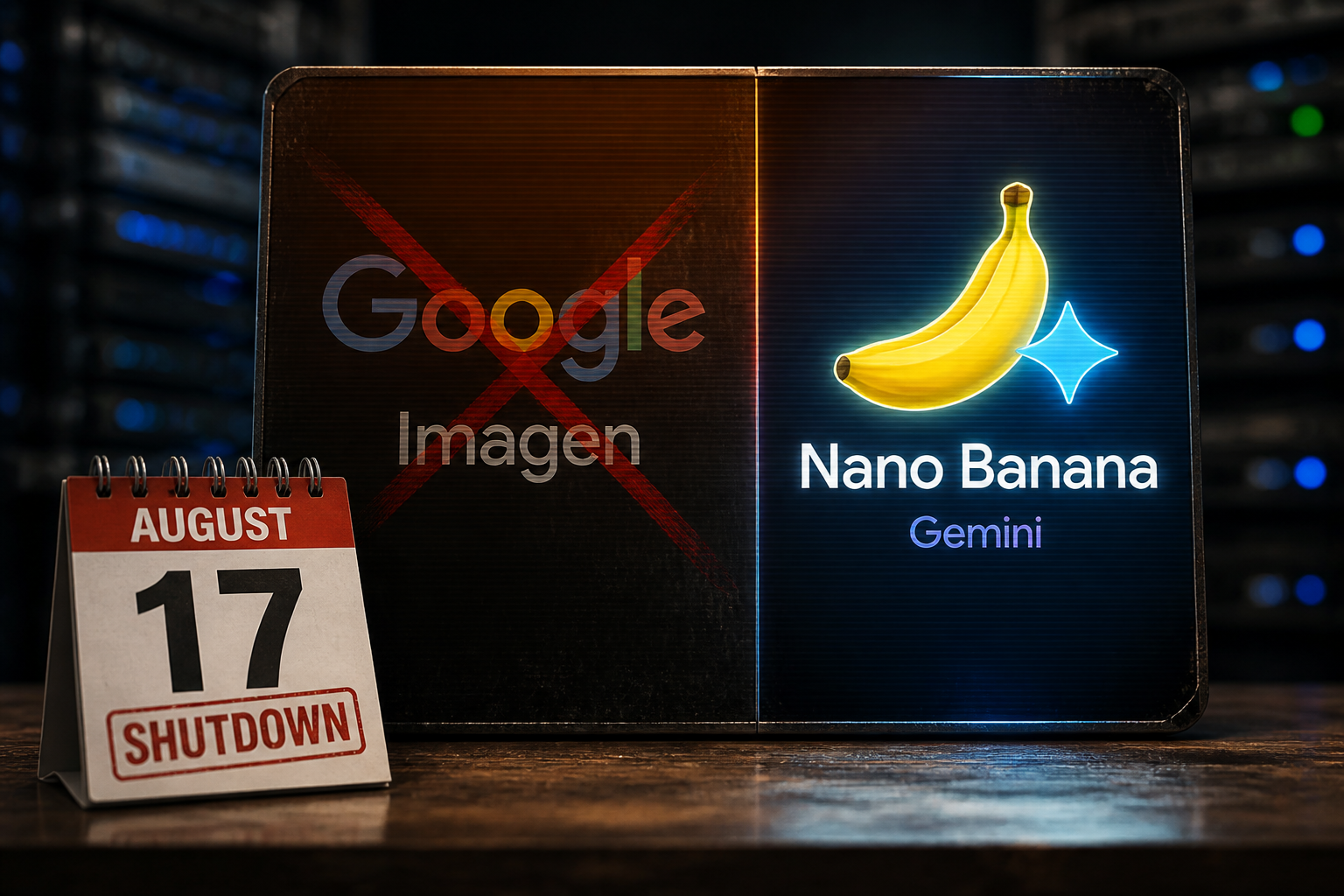
Google shut down Imagen 4 on 17 August 2026. The Gemini API endpoints imagen-4.0-generate-001, imagen-4.0-ultra-generate-001, and imagen-4.0-fast-generate-001 no longer serve. The named replacement is gemini-3.1-flash-image — Nano Banana — and the method is generate_content, not generate_images.
If your production prompt still points at Imagen, it is not degraded. It is dead.
What actually turned off
Google listed the Imagen 4 family on its Gemini API deprecations page and set 17 August 2026 as the hard stop. Standard, Ultra, and Fast all went together. This is not a quality nudge. It is a model-ID retirement.
Imagen 4 had been the dedicated text-to-image lane: English-only prompts, a 480-token cap, one to four images per request, every frame carrying a SynthID watermark. Those constraints shaped a year of recipes. They do not travel as a drop-in.
Nano Banana lives inside the Gemini model family, not as a standalone Imagen endpoint. Images come back as content parts, sometimes beside text, not as a clean generated_images array. You will rewrite the client, not just the string.
Confirm the live table on Google’s deprecations docs before you tell a client the migration is “done.” Vendor pages move.
The prompt does not port. The skill does.
A 480-token English prompt with number_of_images=4 was an Imagen habit. Nano Banana is a Gemini image model. The subject still matters. The API shape changed.
Keep the three-layer system from how to structure image prompts: subject, atmosphere, technical. Do not dump a paragraph of adjectives into generate_content and hope the old Ultra look comes back.
Then segment the prompt like a pro:
- Subject. Who or what is in frame. One hero, not a crowd unless you need a crowd.
- Atmosphere. Light, weather, era, film stock. One mood, not five.
- Technical. Aspect ratio, lens, text-in-image rules, negative space for a UI crop.
Wrap those layers in a skill, not a chat paste. Trigger: “When I paste a product SKU and a channel, generate a 16:9 hero.” Input: SKU, brand tokens, banned claims. Output: one image part plus alt text. Stop after two revisions.
Browse the library for image recipes that already split those jobs. The model ID in the card has to change. The structure should not.
Imagen 4 is a retired endpoint. Nano Banana is a Gemini call. Your skill is the only portable asset.
generate_images is the silent breaker
Most outages today will look like “the prompt got worse.” They are SDK mismatches.
client.models.generate_images() talked to Imagen. client.models.generate_content() talks to Nano Banana. Response handling is the second trap: you walk candidates[0].content.parts and look for inline_data. Text can arrive beside the pixels. Your parser has to tolerate both.
Imagen’s number_of_images (1–4, default 4) does not map cleanly. Several Gemini image docs describe a single image per call; variant grids become a loop, not a parameter. Ultra users who leaned on one high-adherence frame should re-test on gemini-3.1-flash-image instead of assuming a quality downgrade.
English-only was an Imagen rule. If your pipeline translated into English before the 480-token cap, keep that step until you measure Nano Banana on your non-English briefs. Do not delete a guardrail because a brand name changed.
SynthID remains. Google still marks generated images. Invisible provenance is not optional, even after you swap the model string.
What to rewrite this week
Do the mechanical work first. Then the craft.
1. Grep the repo for imagen-4.0 and generate_images. Those strings are outages.
2. Point the client at gemini-3.1-flash-image.
3. Parse content parts. Log whether the model returned text, an image, or both.
4. Rebuild four-up variant flows as four calls with a shared skill, not one batch parameter.
5. Re-run your top 20 image prompts against Nano Banana. Score subject match, text rendering, and crop safety — not vibes.
Gemini the consumer app and the API are different products. Check the tools directory for the surface you actually ship, then freeze the model ID in the skill card so the next deprecation is a search, not an incident.
If you publish a migration note, answer first: who (Google), what (Imagen 4 shutdown), when (17 August 2026), one number (three endpoints). Name “Imagen 4” and “Nano Banana” in the title and lede. Keep a four-question FAQ. Answer engines lift Q&A.
FAQ
What shut down on 17 August 2026? Google retired the Imagen 4 Gemini API family: imagen-4.0-generate-001, imagen-4.0-ultra-generate-001, and imagen-4.0-fast-generate-001. Calls to those IDs should fail, not quietly fall back.
What is Nano Banana? Google’s name for the Gemini image models that replace Imagen. For most Gemini API migrations, the target is gemini-3.1-flash-image. Confirm the live deprecations table before you lock a production ID.
Do I only change the model string? No. Switch generate_images to generate_content and parse image data from content parts. Imagen’s 1–4 image batch parameter is not a safe assumption on the new path.
Are Imagen 4 prompt rules still in force? Imagen 4 was English-only, capped at 480 input tokens, returned 1–4 images, and always applied SynthID. Nano Banana is a different family. Keep English and token discipline until you measure, and assume SynthID still ships on generated stills.
Will my old Ultra prompts look the same? Not guaranteed. Ultra was a dedicated high-adherence Imagen tier. Re-test the same structured prompt on Nano Banana and keep a human review on text-in-image and faces. Structure beats nostalgia.
Sources
- Gemini API deprecations — Google AI for Developers
Reviewed by promptcrates Editorial · Keywords: Imagen 4, Nano Banana, gemini-3.1-flash-image, generate_content, SynthID