
Claude Designed Protein Binders With a 26.8% Lab Hit Rate
Anthropic’s 18 August 2026 research post says Mythos Preview and Opus 4.8 designed de novo minibinders with a vendor-stated 26.8% lab hit rate: 354 of 1,320 tested designs bound. The company reports success on 14 of 15 targets with usable measurements. Independent review is pending.
PromptCrates Editorial
Staff Writer
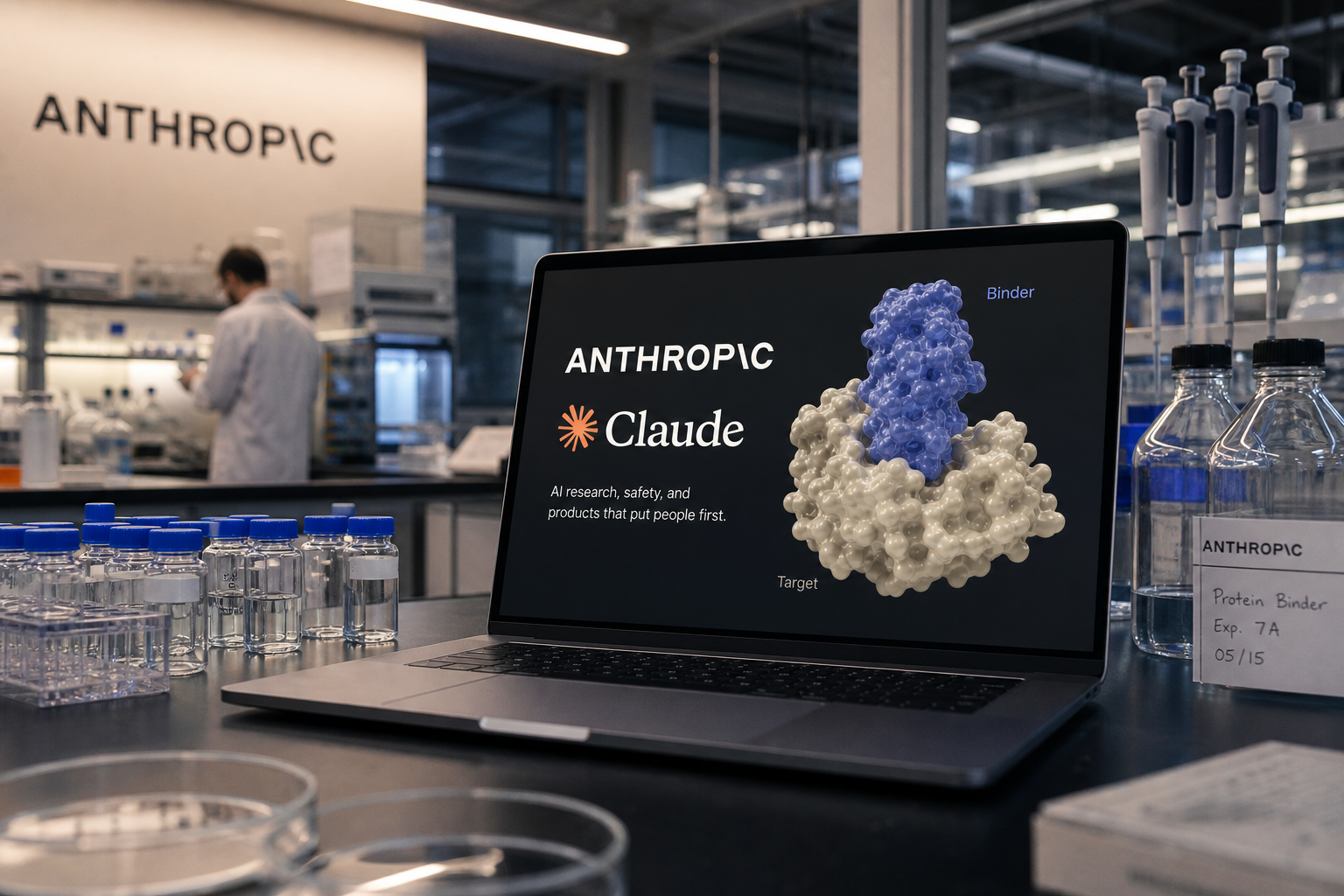
Anthropic said in an 18 August 2026 research post that Claude Science models Mythos Preview and Opus 4.8 designed de novo minibinders with a 26.8% lab hit rate: 354 of 1,320 tested designs bound.
Those figures are vendor-stated. Independent review is pending. Do not treat the percentage as a field standard until someone else runs the same plate.
The work covered 16 targets. Fifteen had usable measurements. Anthropic reports success on 14 of those 15. First-ranked designs bound 49% of the time, per the company. The field range it cites from proteinbase.com is 10–15%.
How Claude protein design actually ran
Claude did not invent a protein model. It installed and ran open-source tools — RFdiffusion, PXDesign, SolubleMPNN, ESMFold2, and others — across about 24 workflows.
The protocol sat in an approximately 16,000-word prompt. That is a Skill prompt at lab scale: named tools, named steps, named stop conditions.
Wet lab work ran at Adaptyv Bio and Twist Bioscience. Binding is what was measured. Structure was not resolved. Biological effect was not shown. Anthropic notes there was no parallel human-expert control.
Data is on Hugging Face. Read the files before you quote the chart.
The 26.8% and the splits underneath it
Multi-target, 48 hours: Mythos Preview 26.7%, Opus 4.8 22.6%, per Anthropic. Single-target Mythos Preview reached 35.1% with 2.8× compute per target. All of that is vendor-stated.
RBX1 is the contest comparison. The contest: 9 of 245 bound. Claude: 28 of 90. Contest winner: 45 nM. Claude’s best on the same plate: 3.9 nM. Those are Anthropic’s numbers on that plate, not a meta-analysis.
TNFα: 12 binders from 150, all from Opus 4.8. MBP: 0 of 90. BBF-14: only three weak binders. The zeros and the weak set are part of the result.
A 16,000-word lab protocol is still an agent loop. Ban novel standing instructions the way the Anthropic and EPFL mind-virus work recommends. OpenAI slowing Astra over critical cyber is a different file. This post is about binders, plates, and a protocol prompt.
A second experiment on raw files, and what it does not prove
In a second experiment, Opus 5 — generally available — read NMR and LC-MS raw files in 23 minutes and 19 minutes. Anthropic reports purity 96.4% versus a lab figure of 96.33%, and it notes baseline caveats. Repeat the caveats. Do not round that into “the model matches the lab.”
Do not collapse the two runs. One is design plus wet lab. The other is file interpretation on a clock.
What this changes in a skill, and what it does not
Pin the tool list. Cap the workflow count. Put the zeros in the hit-rate table. Do not claim biological effect, a resolved structure, or a human-expert control that was not run.
Takeaways:
- 354 / 1,320 bound is Anthropic’s lab figure, 26.8%.
- 14 of 15 measured targets succeeded, per the company.
- MBP was 0 of 90; BBF-14 was three weak binders.
- Binding only. No structure. No biological effect. No parallel expert control.
- Protocol prompt ~16,000 words; ~24 open-source workflows.
Sources
- Claude accelerates protein design — Anthropic, 18 August 2026
- Anthropic on language-model agents running the protein design stack — THE DECODER